
Introduction
Every child explores the world in unique ways. A baby learns by touching objects, a preschooler asks endless “why” questions, and a teenager begins thinking about abstract ideas. These changes are not random—they follow predictable patterns of cognitive growth.
Piaget’s Cognitive Development Theory explains how children’s thinking develops from infancy through adolescence. Developed by Swiss psychologist Jean Piaget, this influential theory transformed the understanding of childhood learning. Rather than viewing children as miniature adults, Piaget argued that they actively construct knowledge through interaction with their environment.
Although modern research has refined some of Piaget’s ideas, his theory remains one of the foundations of developmental psychology and education.
What Is Piaget’s Cognitive Development Theory?
Piaget’s Cognitive Development Theory proposes that children progress through four distinct stages of thinking. Each stage represents a new way of understanding the world.
According to Piaget:
- Children actively build knowledge instead of simply receiving information.
- Cognitive development follows a predictable sequence.
- Every stage prepares children for the next level of thinking.
- Experience and biological maturation work together.
Instead of measuring intelligence by how much children know, Piaget focused on how they think.
Who Was Jean Piaget?
Jean Piaget was a Swiss psychologist born in 1896. His observations of children led him to conclude that intelligence develops gradually through exploration and experience.
Rather than giving children formal tests, Piaget carefully watched how they solved problems, played, and explained their thinking. These observations formed the basis of his developmental theory.
His work continues to influence:
- Psychology
- Education
- Parenting
- Child development research
- Early childhood learning
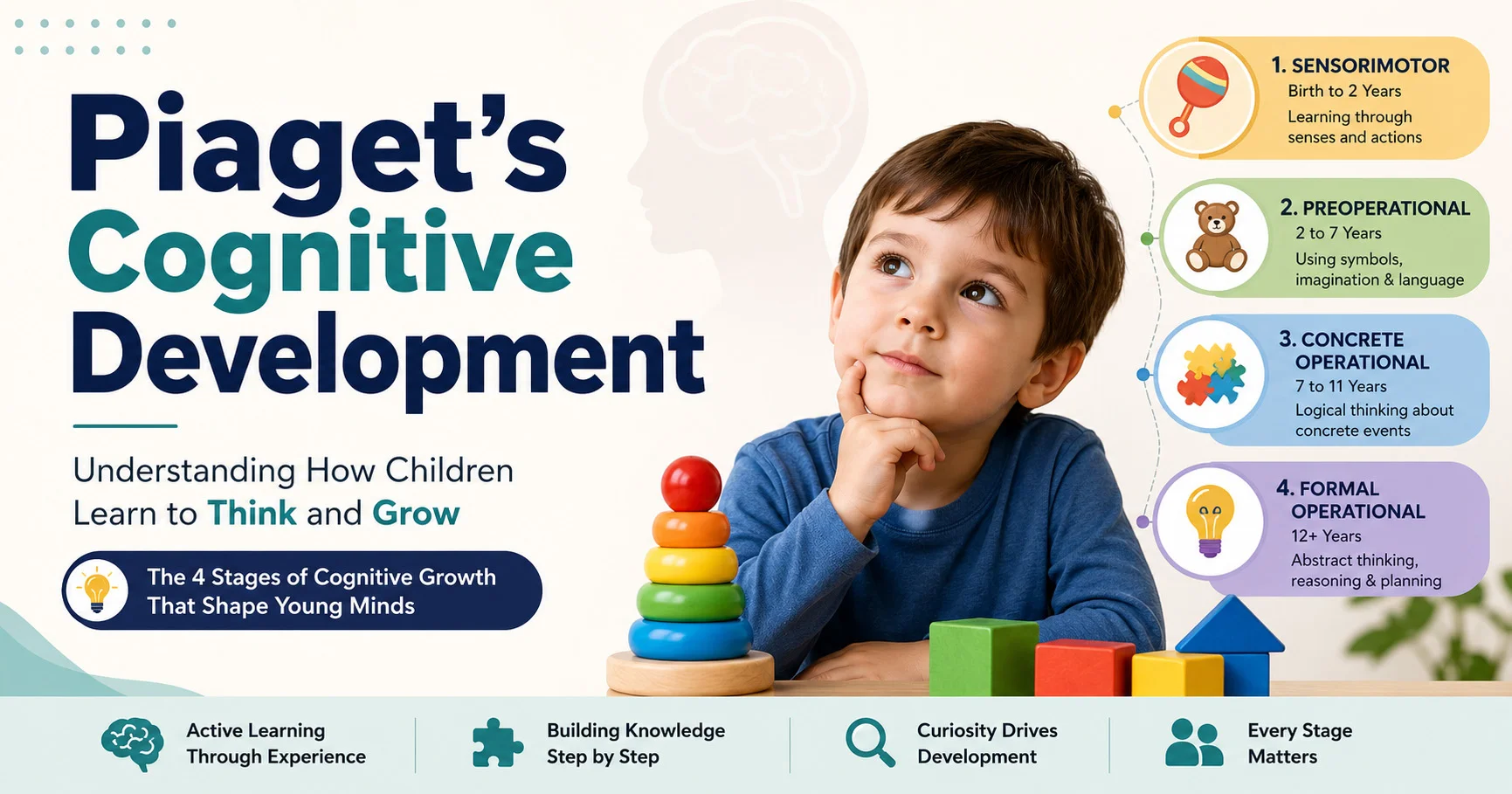
The Four Stages of Cognitive Development
1. Sensorimotor Stage (Birth to About 2 Years)
During this stage, babies learn through their senses and physical actions.
They explore by:
- Touching
- Looking
- Listening
- Grasping
- Crawling
- Putting objects in their mouths
At first, objects seem to disappear when out of sight.
Eventually, babies develop object permanence—the understanding that objects continue to exist even when they cannot be seen.
Key Developments
- Reflexes become intentional actions.
- Cause-and-effect understanding begins.
- Recognition of familiar people develops.
- Simple problem-solving emerges.
- Memory gradually improves.
Everyday Example
A baby searches under a blanket for a hidden toy, demonstrating object permanence.
2. Preoperational Stage (About 2 to 7 Years)
Language develops rapidly during this stage.
Children begin using:
- Words
- Symbols
- Pictures
- Pretend play
Their imagination expands dramatically.
However, logical reasoning is still limited.
Characteristics
Symbolic Thinking
A stick becomes a sword.
A cardboard box becomes a spaceship.
Pretend play strengthens creativity.
Egocentrism
Children often assume everyone sees the world exactly as they do.
This is not selfishness—it reflects a developmental stage in perspective-taking.
Centration
Children focus on one feature while ignoring others.
For example, they may think a taller glass contains more juice even when both glasses hold the same amount.
Everyday Example
A child believes the moon is following them while riding in a car.
3. Concrete Operational Stage (About 7 to 11 Years)
Thinking becomes much more logical.
Children begin solving problems using real, concrete information.
New Cognitive Skills
- Logical reasoning
- Understanding conservation
- Classification
- Ordering objects
- Multiple perspectives
Conservation
Children realize that changing an object’s appearance does not change its quantity.
For example:
Water poured into a taller glass still has the same amount.
This milestone demonstrates improved logical thinking.
Everyday Example
A child correctly groups animals into categories such as mammals, birds, and reptiles.
4. Formal Operational Stage (Around 12 Years and Older)
This stage introduces abstract thinking.
Adolescents begin considering:
- Possibilities
- Hypothetical situations
- Moral questions
- Scientific reasoning
- Future planning
Characteristics
- Critical thinking
- Hypothesis testing
- Strategic planning
- Complex problem solving
- Abstract reasoning
Everyday Example
A teenager debates ethical issues or designs an experiment to test an idea.
The Three Building Blocks of Learning
Piaget believed children organize knowledge using schemas.
Schemas are mental frameworks that help interpret new experiences.
When encountering something new, children use three processes.
Assimilation
New information fits into an existing schema.
Example:
A child who knows dogs may call every four-legged animal a dog.
Accommodation
The schema changes when new information doesn’t fit.
Example:
The child learns that cats are different from dogs.
Equilibration
Children constantly balance assimilation and accommodation.
This process drives learning and intellectual growth.
Why Play Matters
Piaget believed play is one of the most powerful learning tools.
Through play, children develop:
- Creativity
- Memory
- Language
- Social understanding
- Problem-solving skills
Simple activities like building blocks, puzzles, pretend kitchens, and drawing encourage cognitive development.
How Piaget Changed Education
Piaget’s theory shifted education away from memorization toward active learning.
Modern classrooms often encourage students to:
- Explore ideas
- Ask questions
- Solve problems
- Conduct experiments
- Learn through experience
Teachers increasingly act as guides rather than simply delivering information.
Everyday Examples of Piaget’s Theory
Building with Blocks
Children learn balance, size, and spatial reasoning.
Sorting Objects
Grouping toys by color or shape develops classification skills.
Pretend Play
Playing “doctor” or “teacher” strengthens symbolic thinking.
Science Experiments
Older children practice hypothesis testing and logical reasoning.
Strengths of Piaget’s Theory
Piaget’s work remains influential because it:
- Recognized children as active learners.
- Explained how thinking changes with age.
- Encouraged hands-on education.
- Inspired decades of developmental research.
- Improved understanding of childhood learning.
Criticisms of Piaget’s Theory
Modern researchers have identified some limitations.
Development Can Be More Flexible
Children sometimes develop certain abilities earlier than Piaget proposed.
Social Learning Matters
Piaget emphasized independent discovery.
Later psychologists highlighted the importance of parents, teachers, peers, and culture in cognitive growth.
Individual Differences
Not every child reaches milestones at exactly the same age or in the same order.
Development is influenced by:
- Environment
- Learning opportunities
- Experience
- Individual differences
Piaget’s Theory in Today’s World
Although created nearly a century ago, Piaget’s ideas remain relevant.
Parents can apply them by:
- Encouraging curiosity.
- Allowing exploration.
- Asking open-ended questions.
- Supporting independent problem-solving.
- Providing age-appropriate challenges.
Educators continue using Piaget’s principles to design learning experiences that match children’s developmental abilities.
Frequently Asked Questions
What is Piaget’s Cognitive Development Theory?
It explains how children’s thinking develops through four stages, progressing from sensory exploration in infancy to abstract reasoning in adolescence.
What are the four stages of cognitive development?
The four stages are:
- Sensorimotor
- Preoperational
- Concrete Operational
- Formal Operational
Why is Piaget’s theory important?
It transformed the understanding of child development by showing that children actively construct knowledge through experience rather than simply absorbing information.
What is object permanence?
Object permanence is the understanding that objects continue to exist even when they are out of sight. It typically develops during the sensorimotor stage.
What is the difference between assimilation and accommodation?
Assimilation involves fitting new information into existing knowledge, while accommodation involves changing existing knowledge to incorporate new information.
Key Takeaways
- Piaget viewed children as active learners who build knowledge through experience.
- Cognitive development progresses through four major stages.
- Thinking changes qualitatively as children grow.
- Play, exploration, and curiosity are central to learning.
- Piaget’s theory continues to shape education and developmental psychology worldwide.
Final Thoughts
Piaget’s Cognitive Development Theory reminds us that learning is a gradual journey rather than a race. Children are not simply accumulating facts—they are continuously reshaping how they understand the world. By recognizing the different ways thinking evolves across childhood, parents, educators, and caregivers can provide experiences that nurture curiosity, confidence, and lifelong learning. While modern research has expanded on Piaget’s ideas, his central message remains powerful: meaningful learning happens when children actively explore, question, and make sense of the world around them.

Leave a Comment