
Human beings like to believe decisions are based on logic, reason, and careful thinking. However, psychology research shows that the human brain often relies on mental shortcuts that can distort judgment without conscious awareness. These shortcuts are known as cognitive biases, and they influence nearly every aspect of everyday life.
From shopping choices and social interactions to political opinions and workplace decisions, cognitive biases shape how information is interpreted and how actions are taken. Understanding these psychological patterns can improve critical thinking, emotional awareness, and decision-making skills.
What Are Cognitive Biases?
Cognitive biases are systematic thinking errors that affect perception, memory, reasoning, and judgment. They occur because the brain attempts to process information quickly and efficiently rather than carefully analyzing every detail.
The concept became widely recognized through the groundbreaking work of psychologists Daniel Kahneman and Amos Tversky, who demonstrated that people often make irrational decisions even when they believe they are thinking logically.
These biases are connected to heuristics, which are mental shortcuts designed to simplify complex information processing.
Although heuristics help save time and mental energy, they can also lead to flawed conclusions and poor decisions.
Why Cognitive Biases Happen
The human brain processes enormous amounts of information every second. To avoid becoming overwhelmed, the mind filters and simplifies information automatically.
Cognitive biases develop because of several psychological factors, including:
- Limited attention span
- Emotional influences
- Memory limitations
- Social conditioning
- Previous experiences
- Desire for mental efficiency
- Need for quick decision-making
These shortcuts evolved partly as survival mechanisms, helping humans react quickly in uncertain situations. However, modern environments often expose the weaknesses of these automatic thinking patterns.
How Cognitive Biases Affect Everyday Life
Many people assume biases only influence major decisions, but they actually affect daily experiences constantly.
Cognitive biases can shape:
- Consumer behavior
- Relationships
- Political opinions
- Workplace decisions
- Social media interactions
- Financial choices
- Health-related judgments
In many cases, individuals are completely unaware that their thinking has been influenced.
Common Cognitive Biases in Everyday Life
Confirmation Bias
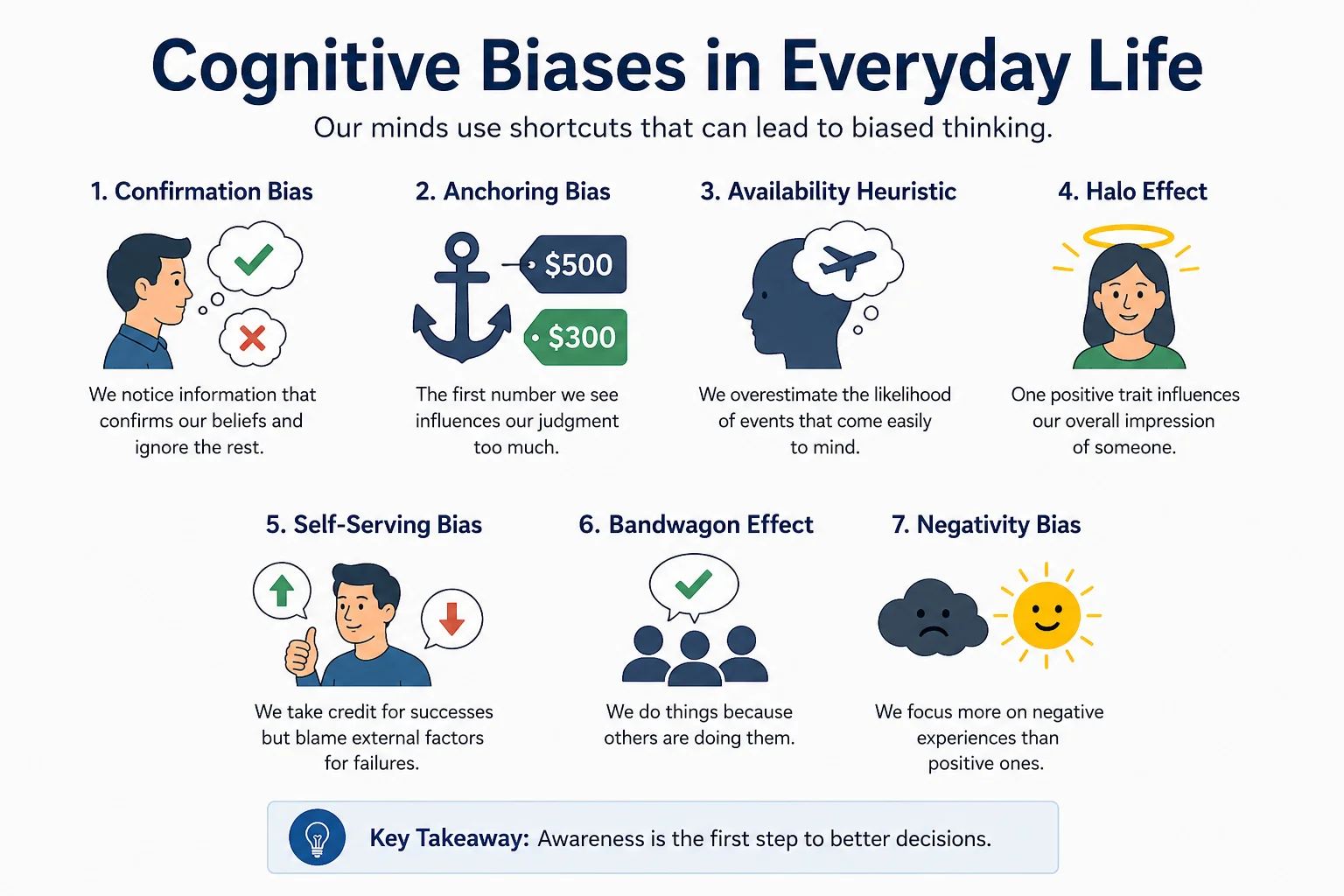
Confirmation bias occurs when people search for information that supports their existing beliefs while ignoring evidence that contradicts them.
Everyday Example
A person who strongly believes a particular fitness trend works may focus only on positive testimonials while dismissing scientific studies showing limited effectiveness.
Real-Life Impact
Confirmation bias can:
- Reinforce misinformation
- Increase political polarization
- Reduce open-minded thinking
- Strengthen stereotypes
How to Reduce Confirmation Bias
- Read opposing viewpoints
- Evaluate evidence from multiple sources
- Question personal assumptions
- Practice critical thinking
Anchoring Bias
Anchoring bias happens when the first piece of information encountered strongly influences later judgments.
Everyday Example
A retailer lists a television at $1,200 before discounting it to $799. Even if the television is still overpriced, the discounted price appears attractive because the original number acts as an anchor.
Real-Life Impact
Anchoring bias affects:
- Online shopping
- Salary negotiations
- Real estate pricing
- Financial decisions
How to Reduce Anchoring Bias
- Compare multiple options
- Research market value independently
- Avoid making fast purchasing decisions
Availability Heuristic
The availability heuristic occurs when people judge situations based on examples that come to mind easily.
Everyday Example
After hearing repeated news stories about shark attacks, some individuals may overestimate the danger of swimming in the ocean despite the extremely low statistical risk.
Real-Life Impact
This bias can:
- Increase fear and anxiety
- Distort risk perception
- Influence public opinion
- Affect health decisions
How to Reduce It
- Check objective statistics
- Avoid relying solely on emotional reactions
- Analyze long-term evidence
Halo Effect
The halo effect occurs when one positive trait influences overall perception.
Everyday Example
A well-dressed employee may automatically be viewed as more competent or intelligent, even without evidence supporting those assumptions.
Real-Life Impact
The halo effect influences:
- Hiring decisions
- Social relationships
- Brand perception
- Celebrity influence
How to Reduce It
- Evaluate people objectively
- Separate appearance from ability
- Focus on measurable evidence
Self-Serving Bias
Self-serving bias causes people to credit personal successes to their abilities while blaming failures on external circumstances.
Everyday Example
An employee who receives a promotion may attribute it entirely to talent and hard work, while blaming a missed opportunity on unfair management.
Real-Life Impact
This bias can:
- Reduce accountability
- Limit personal growth
- Damage teamwork
- Create interpersonal conflict
How to Reduce It
- Practice self-reflection
- Accept constructive feedback
- Analyze failures honestly
Bandwagon Effect
The bandwagon effect occurs when people adopt beliefs or behaviors because many others are doing the same.
Everyday Example
Consumers often purchase trending products on social media because popularity creates the impression that the product must be valuable.
Real-Life Impact
The bandwagon effect influences:
- Fashion trends
- Political movements
- Consumer behavior
- Online culture
How to Reduce It
- Think independently
- Question social trends
- Evaluate evidence before following popular opinions
Negativity Bias
Negativity bias refers to the tendency to focus more strongly on negative experiences than positive ones.
Everyday Example
One critical online comment may emotionally outweigh dozens of positive comments.
Real-Life Impact
Negativity bias can:
- Increase stress levels
- Strengthen pessimistic thinking
- Affect self-esteem
- Influence relationships
How to Reduce It
- Practice gratitude
- Focus on balanced thinking
- Limit exposure to negative media
- Develop emotional awareness
Cognitive Biases in Social Media
Social media platforms often intensify cognitive biases because algorithms prioritize emotionally engaging content.
Examples include:
- Confirmation bias through personalized feeds
- Bandwagon effects from viral trends
- Negativity bias through outrage-based content
- Availability heuristic from repeated news exposure
These patterns can significantly influence opinions, emotions, and behavior online.
Cognitive Biases in the Workplace
Biases frequently affect professional environments and organizational decisions.
Hiring Bias
Recruiters may unconsciously favor candidates based on:
- Appearance
- Similar backgrounds
- Shared interests
- Educational reputation
Leadership Decisions
Managers may unintentionally:
- Favor familiar employees
- Ignore contradictory feedback
- Make emotionally driven decisions
Many organizations now use structured interviews and evidence-based hiring methods to reduce unconscious bias.
Can Cognitive Biases Be Eliminated?
Completely eliminating cognitive biases is unlikely because they are deeply connected to human cognition and brain efficiency. However, awareness can significantly reduce their influence.
Research in cognitive psychology suggests that reflective thinking and analytical decision-making help improve judgment accuracy.
Practical Ways to Reduce Cognitive Biases
Slow Down Important Decisions
Fast thinking increases reliance on automatic mental shortcuts.
Seek Different Perspectives
Exposure to diverse viewpoints reduces narrow thinking patterns.
Use Evidence-Based Reasoning
Data and facts help counter emotional assumptions.
Reflect Before Reacting Emotionally
Strong emotions often intensify biased thinking.
Practice Metacognition
Metacognition involves analyzing personal thinking processes and recognizing potential mental distortions.
Why Understanding Cognitive Biases Matters
Understanding cognitive biases is important because these patterns influence nearly every area of life.
Awareness can improve:
- Decision-making skills
- Emotional intelligence
- Communication
- Problem-solving ability
- Financial judgment
- Relationship quality
In an era of information overload and digital influence, recognizing cognitive biases has become increasingly valuable.
Final Thoughts
Cognitive biases are a natural part of human psychology. While these mental shortcuts help the brain process information efficiently, they can also distort perception and lead to irrational decisions.
Learning to recognize these patterns can improve self-awareness, encourage critical thinking, and support healthier decision-making in everyday life. Although biases may never disappear completely, understanding how they operate allows individuals to make more informed and balanced judgments.


Leave a Comment