
Introduction
Have you ever caught a ball before you had time to think about it? Or finished someone’s sentence before they said the last word? Maybe you have reached for a light switch in a familiar room without even looking.
These everyday moments reveal something amazing about the human brain.
Most people think the brain simply reacts to the world around it. In reality, it does much more than that. Your brain is constantly trying to predict what will happen next. It makes quick guesses about people, places, sounds, emotions, and situations before they actually happen.
Scientists call this predictive processing. It is one of the brain’s most important abilities because it helps us move faster, make decisions, and understand the world with less effort.
The good news is that these predictions are not fixed. They change every time you learn something new or have a new experience.
What Does It Mean That the Brain Predicts the Future?
When we say the brain predicts the future, we are not talking about seeing tomorrow or having special powers.
Instead, your brain uses everything it has learned from the past to guess what is most likely to happen in the next few seconds.
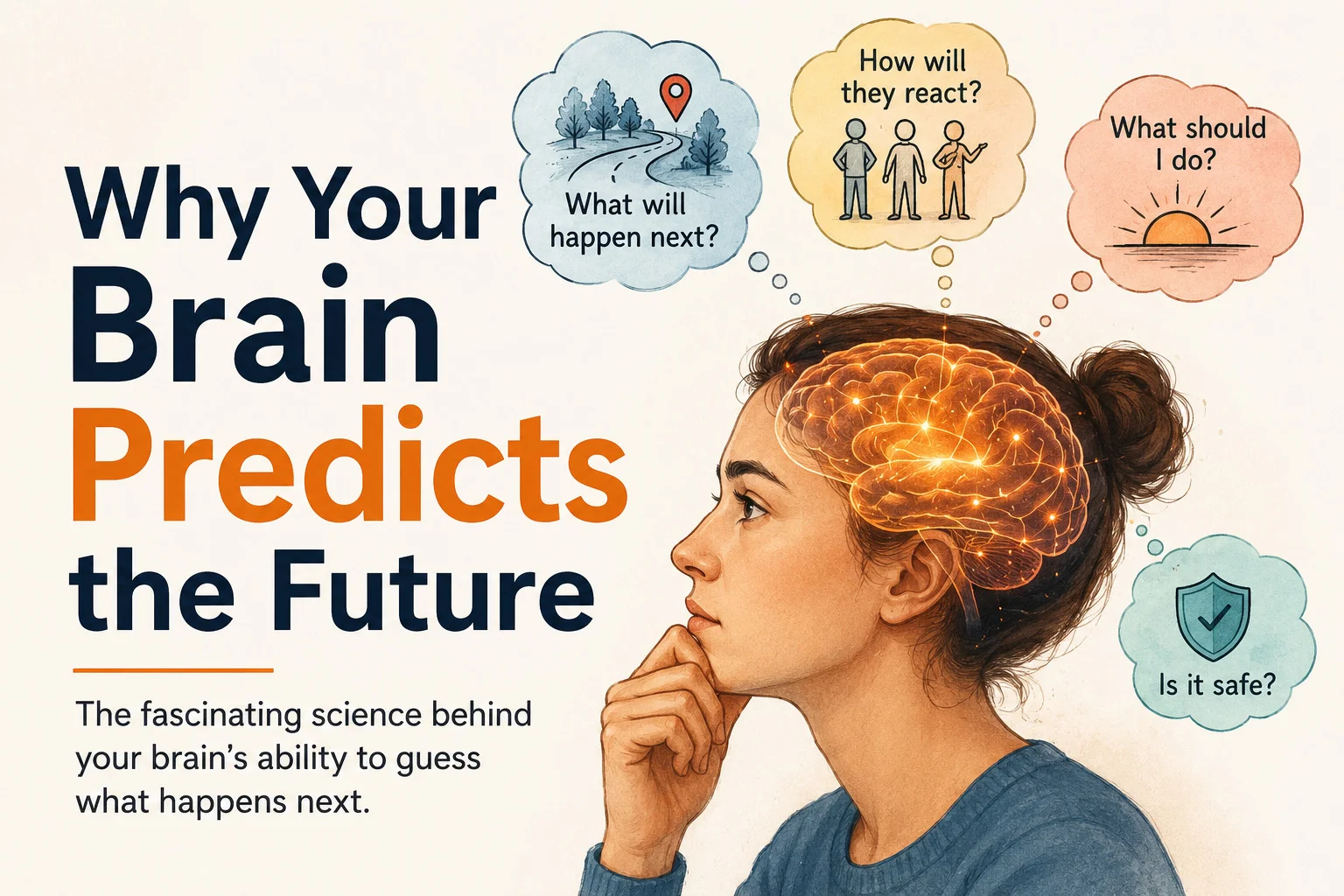
For example, your brain is always asking questions like these:
- What will I see next?
- What sound is coming?
- How will this person respond?
- Is this place safe?
- What should I do next?
These predictions happen automatically. Most of the time, you do not even notice them.
Why Does the Brain Make Predictions?
Imagine if your brain had to study every little detail before making a decision.
Crossing a busy road would take much longer.
Playing sports would become almost impossible.
Even having a simple conversation would feel slow.
Instead, your brain predicts what is likely to happen so you can react quickly.
This saves time and mental energy.
It also allows you to focus on the things that matter most instead of thinking about every tiny detail.
How Does the Brain Learn to Predict?
The brain learns through experience.
Every day, it collects information about the world. Over time, it notices patterns and remembers them.
For example:
Your Morning Routine
If you wake up and make coffee every morning, your brain starts expecting that routine.
After a while, you may begin preparing the next step without thinking about it.
Talking to Friends
You probably know when one of your friends is about to tell a joke or laugh.
Your brain has learned their usual behavior.
Listening to Music
When you hear your favorite song, you often know the next lyric before it is sung.
That is your brain using memory to make a prediction.
Reading
Even while reading this article, your brain is guessing the next word before your eyes reach it.
Sometimes it is right.
Sometimes it is not.
Your Brain Works Faster Than Your Thoughts
Many actions happen before you become fully aware of them.
For example, if someone throws you a ball, your hands begin moving before you consciously decide to catch it.
This happens because your brain has already predicted where the ball will go.
Without this ability, everyday life would feel much slower and much harder.
How the Brain Learns From Mistakes
The brain is always comparing two things.
What it expected to happen.
What actually happened.
If both match, the brain keeps using that pattern.
If they do not match, the brain notices the difference and starts learning.
This is called a prediction error.
Prediction errors are actually helpful because they teach the brain something new.
Think about these examples:
- Someone reacts in a way you did not expect.
- Your usual road is closed.
- A movie has an unexpected ending.
- A magician performs a trick that surprises you.
These moments grab your attention because your brain realizes it needs to update its expectations.
Why Surprises Are So Memorable
Have you ever received a gift you never expected?
Or heard news that completely shocked you?
Surprises create a strong prediction error.
Your brain immediately pays attention because it thinks something important has happened.
That is one reason surprising moments often stay in your memory for a long time.
Why Habits Feel Automatic
Habits are built through repetition.
The more often you repeat an action, the better your brain becomes at predicting it.
Eventually, you no longer need to think about each step.
Examples include:
- Brushing your teeth
- Driving to work
- Typing on a keyboard
- Locking your front door
These actions become easier because your brain already knows what comes next.
Why Change Feels Difficult
People often wonder why it is so hard to build new habits or break old ones.
The answer is simple.
Your brain likes familiar patterns.
When you start something new, your brain cannot predict what will happen as easily.
That is why learning a new skill, moving to a new place, or starting a new job can feel uncomfortable at first.
As you gain more experience, your brain creates new patterns.
Eventually, those new behaviors begin to feel natural.
How Predictions Affect Your Emotions
Your brain does not only predict physical events.
It also predicts emotional and social situations.
For example, if someone has been embarrassed during public speaking before, they may expect it to happen again.
Even if nothing goes wrong, that expectation can increase nervousness.
The opposite is also true.
Positive experiences help the brain build more confident expectations over time.
Why Two People See the Same Situation Differently
Have you ever noticed that two people can experience the same event but describe it differently?
That happens because each person’s brain has learned from different experiences.
One person may expect something positive.
Another may expect something negative.
Their expectations shape how they see the situation.
This is why first impressions, personal experiences, and beliefs can influence the way people understand the world.
Can the Brain Make Wrong Predictions?
Yes.
The brain is very smart, but it is not perfect.
Sometimes it relies on old experiences that no longer match the present.
For example, you might expect someone to dislike you because of a bad experience with another person years ago.
Or you may expect to fail simply because you failed once before.
The good news is that the brain can always learn something new.
Every new experience gives it another chance to improve its predictions.
How Can You Help Your Brain Make Better Predictions?
Here are a few simple ways to improve the way your brain learns.
Stay Curious
Do not assume you already know the answer.
Being curious helps your brain collect better information.
Try New Experiences
Travel, read, learn new skills, and meet different people.
New experiences teach the brain new patterns.
Question Your Assumptions
Ask yourself,
“Am I reacting to what is happening now, or to something that happened in the past?”
Learn From Mistakes
Mistakes are not failures.
They are opportunities for your brain to improve.
Build Healthy Habits
The more often you repeat positive behaviors, the easier they become over time.
Frequently Asked Questions
Does the brain really predict the future?
Yes, but not in a magical way. The brain uses past experiences to guess what is most likely to happen next.
Why is prediction important?
Prediction helps you react faster, save mental energy, and make better decisions in everyday life.
Can the brain make wrong predictions?
Yes. Predictions are based on past experiences, so they are not always correct. New experiences help improve them.
Can people train their brains to make better predictions?
Yes. Learning new things, staying curious, and trying different experiences all help the brain become more accurate over time.
Key Takeaways
- Your brain is constantly predicting what will happen next.
- These predictions are based on your past experiences.
- Prediction helps you react quickly and saves mental energy.
- Surprises help the brain learn because they challenge its expectations.
- Habits become automatic because the brain learns repeated patterns.
- New experiences help the brain improve its predictions.
- The more you learn, the better your brain becomes at understanding the world.
Final Thoughts
Your brain is always working ahead of you. It uses your past experiences to prepare you for what is most likely to happen next. Most of the time, you never notice this process because it happens automatically.
The exciting part is that your brain is always learning. Every book you read, every conversation you have, and every new experience you try helps your brain build better predictions.
The future may be uncertain, but your brain is constantly preparing you for it. The more you learn and grow, the better those predictions become.

Leave a Comment