
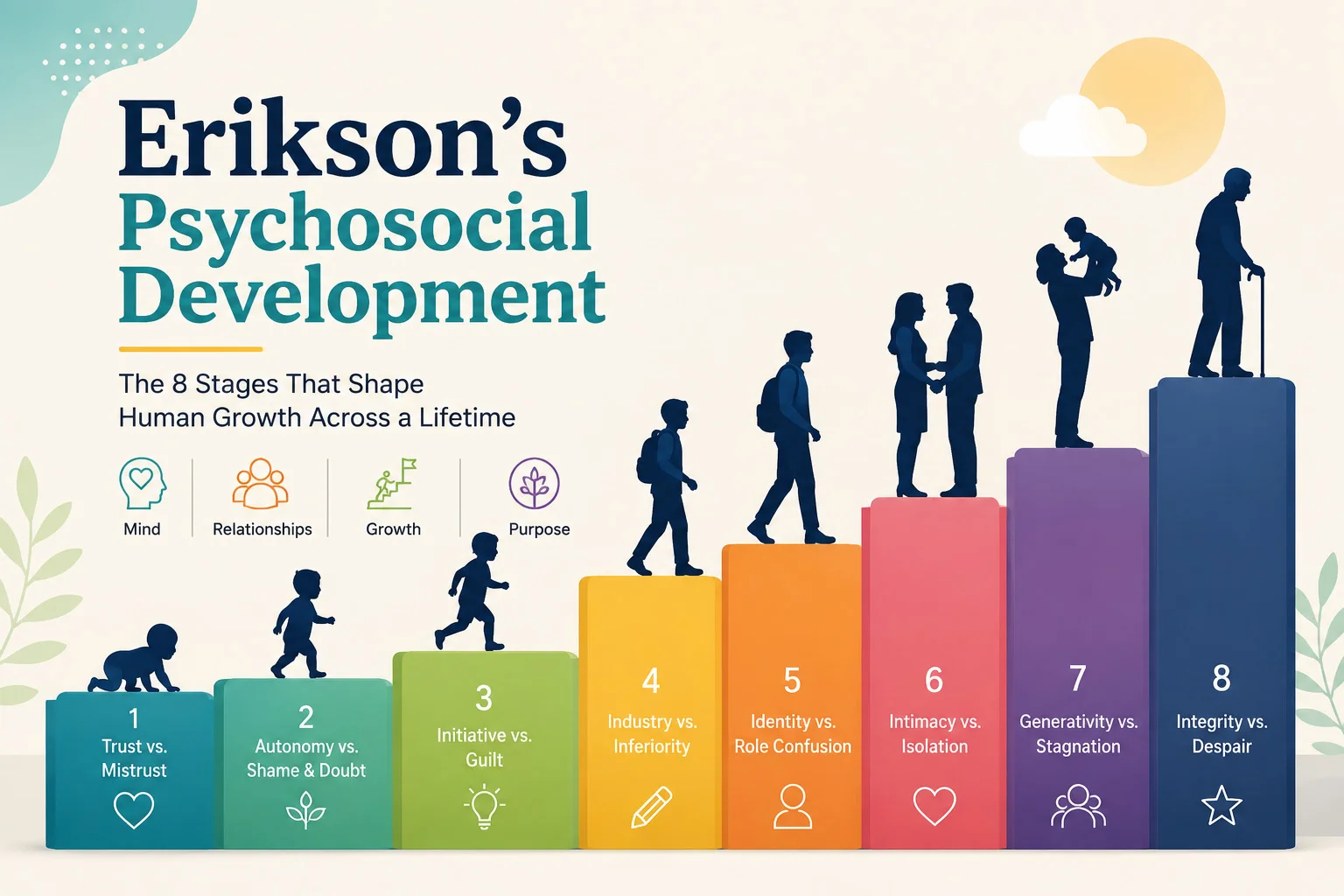
Human development is about much more than physical growth. From infancy to old age, every stage of life presents unique social and psychological challenges that influence personality, relationships, confidence, and decision-making.
One of the most influential theories explaining this lifelong journey is Erikson’s Psychosocial Development Theory. Developed by psychologist Erik Erikson, the theory proposes that people pass through eight psychosocial stages, each involving a conflict that must be resolved for healthy psychological growth.
Unlike theories that focus only on childhood, Erikson believed development continues throughout the entire lifespan. Each successful resolution strengthens a person’s ability to handle future challenges, while unresolved conflicts may create difficulties later in life.
This article explores every stage of Erikson’s theory, why it remains important today, and how it can help explain everyday human behavior.
What Is Erikson’s Psychosocial Development Theory?
Erikson’s Psychosocial Development Theory explains that personality develops through a series of social experiences.
At every stage of life, individuals encounter a psychological conflict between two opposing forces. Successfully managing the conflict develops an important psychological strength, while failing to resolve it may create insecurity or emotional struggles.
The theory emphasizes the interaction between:
- Biological growth
- Social relationships
- Cultural influences
- Personal experiences
Together, these shape how individuals think, behave, and relate to others.
Why Is It Called Psychosocial Development?
The word psychosocial combines two important ideas:
- Psychological — thoughts, emotions, beliefs, and identity.
- Social — relationships with family, friends, schools, workplaces, and society.
Erikson believed these two aspects constantly influence each other throughout life.
The Eight Stages of Erikson’s Psychosocial Development
1. Trust vs. Mistrust (Birth to 18 Months)
Main Question
“Can I trust the world?”
Infants depend entirely on caregivers for food, comfort, warmth, and protection.
When caregivers respond consistently and lovingly, babies develop trust.
If care is unpredictable or neglectful, mistrust may develop.
Positive Outcome
- Feeling safe
- Confidence in others
- Emotional security
Possible Challenges
- Fearfulness
- Anxiety
- Difficulty trusting people
2. Autonomy vs. Shame and Doubt (18 Months to 3 Years)
Main Question
“Can I do things on my own?”
Toddlers begin exploring independence.
Simple activities like walking, dressing, feeding themselves, and making choices help build confidence.
Supportive guidance encourages autonomy.
Overly critical parenting may create shame and self-doubt.
Positive Outcome
- Independence
- Confidence
- Self-control
Possible Challenges
- Self-doubt
- Fear of making mistakes
- Excessive dependence on others
3. Initiative vs. Guilt (3 to 5 Years)
Main Question
“Is it okay for me to take action?”
Children become curious and imaginative.
They enjoy asking questions, pretending, creating games, and solving simple problems.
Encouragement builds initiative.
Constant criticism may create guilt about taking action.
Positive Outcome
- Leadership
- Creativity
- Motivation
Possible Challenges
- Hesitation
- Fear of trying new things
- Low confidence
4. Industry vs. Inferiority (6 to 12 Years)
Main Question
“Am I capable?”
School introduces children to learning, teamwork, achievement, and responsibility.
Success develops competence.
Repeated failure without support may create feelings of inferiority.
Positive Outcome
- Skill development
- Confidence
- Persistence
Possible Challenges
- Low self-esteem
- Giving up easily
- Feeling less capable than peers
5. Identity vs. Role Confusion (12 to 18 Years)
Main Question
“Who am I?”
Adolescence is often considered Erikson’s most influential stage.
Teenagers explore:
- Values
- Career interests
- Friendships
- Beliefs
- Personal goals
Successfully forming an identity creates confidence.
Failure may result in confusion about one’s future and sense of self.
Positive Outcome
- Strong identity
- Clear values
- Direction in life
Possible Challenges
- Confusion
- Peer pressure
- Uncertainty about goals
6. Intimacy vs. Isolation (Young Adulthood)
Main Question
“Can I build meaningful relationships?”
Young adults seek close emotional connections.
Healthy identity makes genuine intimacy possible.
Difficulty trusting others may lead to isolation.
Positive Outcome
- Strong friendships
- Healthy romantic relationships
- Emotional closeness
Possible Challenges
- Loneliness
- Fear of commitment
- Emotional distance
7. Generativity vs. Stagnation (Middle Adulthood)
Main Question
“Am I contributing to society?”
Adults often focus on making a meaningful contribution through:
- Parenting
- Mentoring
- Careers
- Volunteering
- Community involvement
Helping future generations creates purpose.
A lack of contribution may lead to stagnation.
Positive Outcome
- Purpose
- Productivity
- Caring for others
Possible Challenges
- Feeling stuck
- Self-centeredness
- Lack of fulfillment
8. Integrity vs. Despair (Older Adulthood)
Main Question
“Was my life meaningful?”
Older adults reflect on their lives.
Accepting both successes and failures leads to integrity.
Deep regret may lead to despair.
Positive Outcome
- Wisdom
- Acceptance
- Peace
Possible Challenges
- Regret
- Hopelessness
- Bitterness
Summary of Erikson’s Eight Stages
| Stage | Age | Conflict | Positive Strength |
|---|---|---|---|
| Trust vs. Mistrust | Birth–18 months | Safety | Hope |
| Autonomy vs. Shame | 18 months–3 years | Independence | Will |
| Initiative vs. Guilt | 3–5 years | Taking action | Purpose |
| Industry vs. Inferiority | 6–12 years | Competence | Skill |
| Identity vs. Role Confusion | Adolescence | Self-identity | Fidelity |
| Intimacy vs. Isolation | Young adulthood | Relationships | Love |
| Generativity vs. Stagnation | Middle adulthood | Contribution | Care |
| Integrity vs. Despair | Older adulthood | Reflection | Wisdom |
Why Is Erikson’s Theory Still Relevant Today?
Although developed decades ago, Erikson’s ideas remain highly relevant because people continue facing similar developmental challenges throughout life.
The theory is widely applied in:
- Education
- Parenting
- Career development
- Leadership training
- Personal growth
- Human development research
It helps explain why individuals respond differently to life’s opportunities and setbacks.
What Are the Strengths of Erikson’s Theory?
Researchers and educators value the theory because it:
- Covers the entire lifespan
- Emphasizes social relationships
- Explains personality development
- Highlights lifelong learning
- Encourages healthy emotional growth
Its practical nature makes it useful in classrooms, workplaces, and everyday life.
What Are the Limitations?
Despite its influence, the theory has some limitations.
- Human development is often more flexible than fixed stages.
- People may revisit earlier challenges later in life.
- Cultural experiences vary across societies.
- Individual personalities differ significantly.
Modern psychology generally views Erikson’s stages as helpful guidelines rather than strict rules.
How Can This Theory Be Applied in Everyday Life?
Understanding Erikson’s stages can encourage more supportive interactions across all ages.
For example:
- Parents can nurture trust and independence in young children.
- Teachers can build confidence by recognizing effort and progress.
- Teenagers can be supported as they explore identity without excessive pressure.
- Adults may find purpose by mentoring others or contributing to their communities.
- Older adults can benefit from opportunities to share life experiences and reflect with meaning.
Recognizing the developmental tasks associated with different life stages can promote empathy, patience, and healthier relationships.
Frequently Asked Questions
Who developed Erikson’s Psychosocial Development Theory?
The theory was developed by psychologist Erik Erikson, who proposed that personality develops through eight psychosocial stages across the lifespan.
How many stages are in Erikson’s theory?
The theory includes eight stages, beginning in infancy and continuing through older adulthood.
Why is the identity stage important?
The stage of Identity vs. Role Confusion is significant because it involves forming a stable sense of self, including personal values, goals, and direction in life.
Does everyone pass through the stages in the same way?
Not necessarily. While the stages follow a general sequence, individuals may experience them differently depending on personality, culture, relationships, and life circumstances.
What is the main idea behind Erikson’s theory?
The central idea is that people continue developing psychologically throughout life, and successfully resolving the challenges at each stage supports healthy personality growth and stronger relationships.
Final Thoughts
Erikson’s Psychosocial Development Theory offers a practical framework for understanding how people grow from infancy through older adulthood. By emphasizing the importance of relationships, social experiences, and lifelong development, it highlights that growth does not end in childhood.
Rather than viewing personality as fixed, the theory suggests that every stage of life brings new opportunities to build confidence, strengthen relationships, discover purpose, and gain wisdom. Whether applied in parenting, education, leadership, or personal development, Erikson’s model remains a valuable guide for understanding the human journey.
Key Takeaways
- Personality develops across the entire lifespan.
- Every life stage presents a psychosocial challenge.
- Successfully resolving each challenge strengthens psychological growth.
- Social relationships play a central role in development.
- Growth and learning continue well into older adulthood.

Leave a Comment