
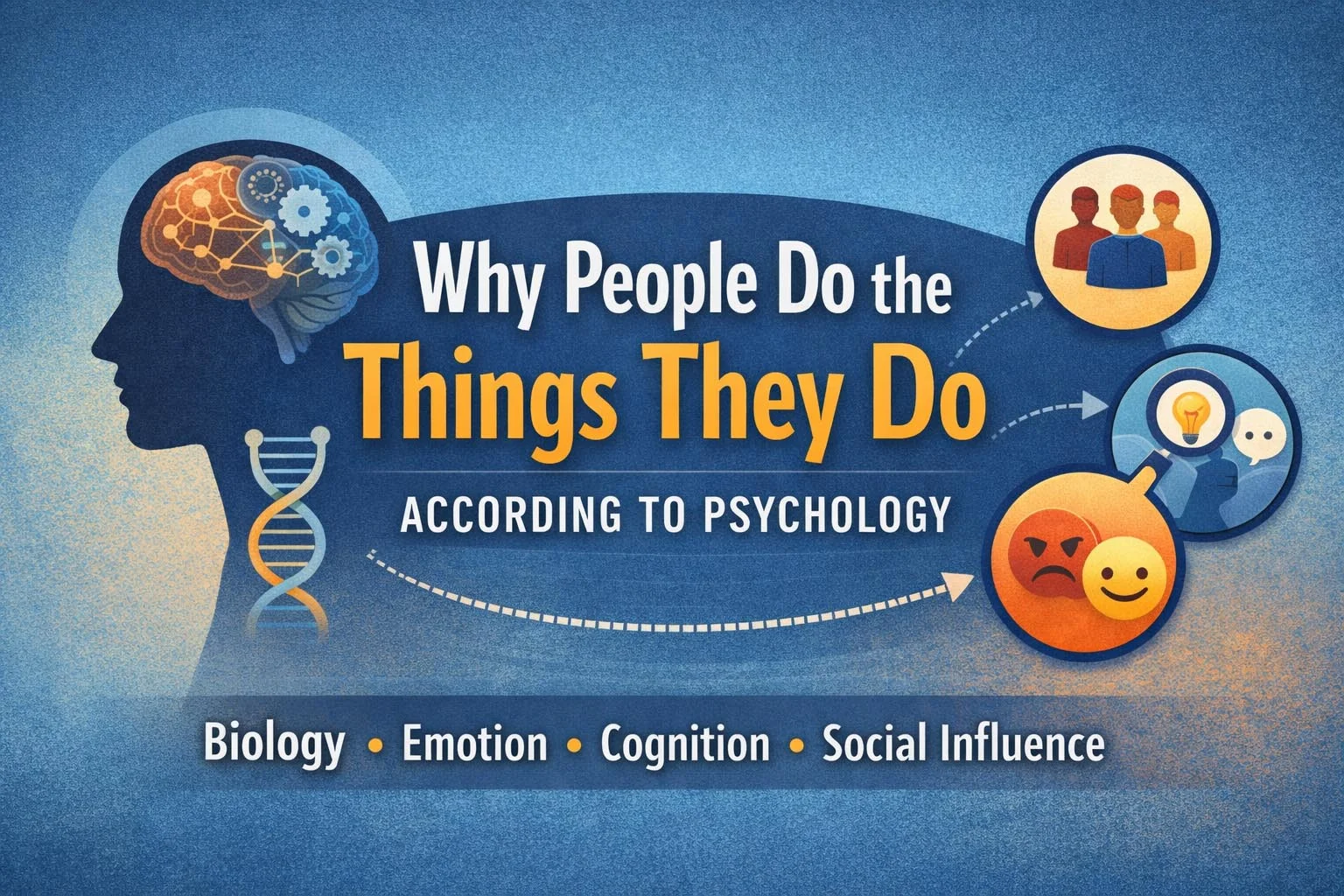
What does psychology mean by human behavior?
In psychology, human behavior refers to observable actions, reactions, and recurring patterns that emerge from the interaction between mental processes and environmental conditions. Behavior is not viewed as accidental or purely intentional. It is understood as the outcome of multiple psychological systems operating simultaneously.
Rather than focusing on isolated actions, psychology examines behavior as a dynamic process influenced by cognition, emotion, biology, learning history, personality, and social context. This perspective explains why behavior can appear consistent in some situations and highly variable in others.
Why does a single explanation never fully explain behavior?
Psychology adopts an interactional view of behavior. Actions are shaped by continuous interaction between internal psychological factors and external circumstances.
Behavior can be understood as the result of:
- Internal factors such as temperament, emotional state, beliefs, and past experiences
- External factors such as social environment, cultural norms, stressors, and situational demands
A change in context can significantly alter behavior even when the individual remains the same. This explains why a person may display confidence in one environment and withdrawal in another without any change in underlying ability or character.
How does perception shape behavior more than reality itself?
One of the most established psychological findings is that behavior is driven by perception rather than objective reality. Individuals respond to how situations are interpreted, not to the situation itself.
The brain filters information through prior experiences, beliefs, emotional memories, and expectations. As a result, identical circumstances can trigger entirely different behavioral responses across individuals. Perception acts as a psychological lens, shaping meaning before behavior occurs.
What role does biology play in influencing behavior?
Biological systems provide the foundation upon which behavior develops. Brain structure, neural pathways, neurotransmitter activity, genetic predispositions, and hormonal regulation all influence emotional intensity, impulse control, motivation, and stress sensitivity.
These biological factors do not determine behavior in a fixed manner. Instead, they create tendencies and thresholds. Psychological learning, emotional regulation skills, and environmental context determine how these biological predispositions are expressed behaviorally.
How does cognition influence behavioral responses?
Cognition refers to mental processes such as thinking, reasoning, memory, interpretation, and decision making. Cognitive processes act as the intermediary between external events and behavioral reactions.
Thought patterns influence how situations are evaluated and how consequences are anticipated. When cognition is flexible and accurate, behavior tends to be adaptive. When thinking becomes distorted or rigid, behavior often follows maladaptive patterns such as avoidance, defensiveness, or impulsivity.
Why are cognitive shortcuts both useful and problematic?
The human brain relies on cognitive shortcuts to conserve energy and manage information overload. These shortcuts allow rapid decision making and efficient functioning in daily life.
However, when these shortcuts become biased or inaccurate, they distort perception and judgment. Cognitive distortions can lead to misinterpretation of social cues, exaggerated threat perception, and repetitive unhelpful behaviors. Over time, these patterns reinforce themselves unless consciously addressed.
How do emotions regulate and direct behavior?
Emotions serve as adaptive signals that guide attention, motivation, and action. Emotional states influence what is noticed, how information is processed, and which behavioral responses are activated.
Effective emotional regulation allows emotions to inform behavior without overwhelming it. When regulation is limited, emotions may drive impulsive, avoidant, or reactive behavior. The behavioral impact of emotion depends not only on emotional intensity but also on regulation capacity.
Why do habits strongly govern daily behavior?
A significant portion of daily behavior operates through habits rather than deliberate choice. Habits form through repeated associations between cues, responses, and outcomes.
Once established, habitual behaviors require minimal cognitive effort and are triggered automatically by environmental or internal cues. This efficiency supports functioning but also makes habits resistant to change. Sustainable behavior change requires modifying cues, environments, and reinforcement patterns rather than relying solely on conscious intention.
How does learning history shape behavioral patterns?
Behavior is continuously shaped through learning mechanisms such as reinforcement, punishment, observation, and repetition. Past experiences influence expectations and guide future behavior, often outside conscious awareness.
Early learning experiences can establish enduring patterns, but learning remains active throughout life. New environments, feedback, and insight can reshape behavior, demonstrating the adaptability of human behavior across time.
What role does personality play in behavior?
Personality reflects relatively stable patterns of thinking, feeling, and behaving. Personality traits influence how individuals approach challenges, regulate emotions, relate to others, and respond to stress.
Personality does not rigidly determine behavior. Instead, it increases the probability of certain responses under specific conditions. Situational demands and environmental factors continue to shape behavior alongside personality traits.
Why does social context exert such strong influence on behavior?
Human behavior is inherently social. Social norms, group expectations, cultural values, and interpersonal relationships strongly influence actions and decisions.
Individuals often adjust behavior to align with group norms, seek acceptance, or avoid social rejection. In certain contexts, social influence can override personal beliefs or values, highlighting the powerful role of environment in shaping behavior.
How does stress alter thinking and behavior?
Stress significantly affects cognitive and emotional functioning. Under stress, attention narrows, emotional reactivity increases, and flexible problem-solving decreases.
Chronic stress reinforces habitual responses and reduces behavioral flexibility. In such states, behavior becomes more reactive and less reflective, making change difficult without first addressing stress regulation.
Why do unconscious processes influence behavior?
A substantial portion of behavior is driven by unconscious psychological processes. Automatic thoughts, implicit attitudes, and emotional memories influence reactions before conscious reasoning occurs.
These processes explain why behavior may conflict with intentions or stated values. Awareness alone is often insufficient for change; consistent practice and environmental modification are typically required to influence unconscious drivers.
Can human behavior be changed according to psychology?
Psychological research supports the view that behavior is changeable. Effective change typically involves multiple levels, including awareness of thought patterns, emotional regulation, habit restructuring, and environmental adjustment.
Lasting behavior change occurs when cognitive, emotional, behavioral, and contextual factors are addressed together rather than in isolation.
What is the most important psychological insight about human behavior?
The most important insight is that human behavior is multidimensional and adaptive. Behavior reflects continuous interaction between biological predispositions, mental processes, emotional states, learning history, personality, and social environment.
Psychology emphasizes understanding patterns and influences rather than assigning simple causes. This perspective allows for more accurate explanations, reduced judgment, and more effective approaches to behavior change.

Leave a Comment