
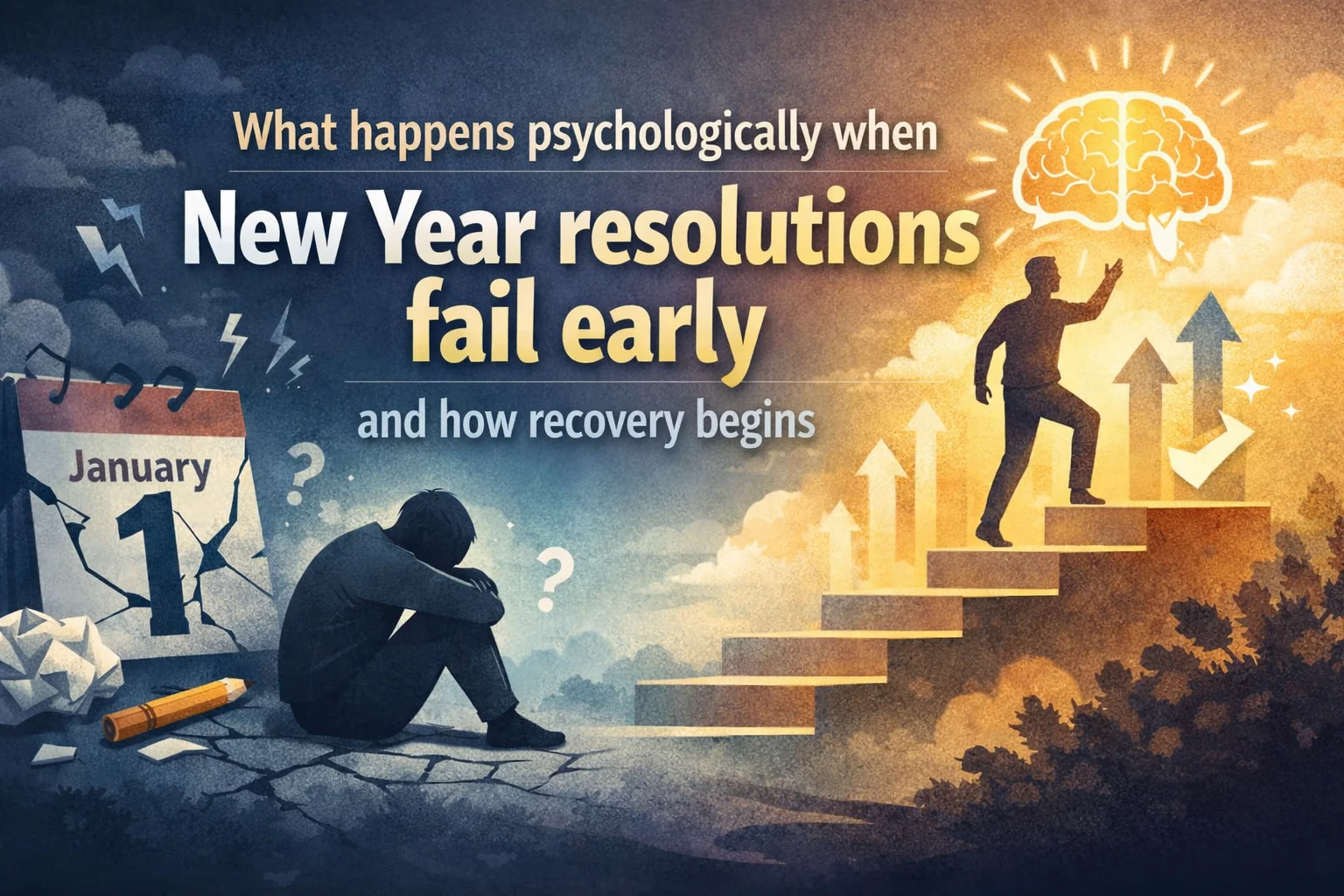
Ah, January. The air is thick with the “fresh start effect.” We’ve all felt that invigorating rush on January 1st, the conviction that this is the year everything changes.
But then, the “January Crash” hits. By mid-month, the gym shoes are gathering dust, or the meal prep containers are buried under a pizza box. If you feel a deep sense of defeat right now, you aren’t alone. In fact, your distress isn’t a sign of weakness, it’s a byproduct of how the human brain processes “New Beginnings.”
Here is the science behind why we fall, and the psychological roadmap to getting back up.
1. Why the “Early Fail” Feels So Personal
When we set a resolution, we aren’t just changing a behavior; we are auditioning for a “New Identity.” * Identity Renewal: Because the New Year is a symbolic reset, we view a slip-up not as a simple mistake, but as a “stain” on our new self.
- The Brain’s Alarm: Your brain treats these goals as high-salience commitments. When you miss a day, your internal “threat system” flares up, triggering feelings of regret and inadequacy that are way out of proportion to the actual event.
2. Shame vs. Guilt: The Silent Saboteurs
After a setback, we usually fall into one of two emotional camps:
- Guilt: “I did something bad” (focuses on the behavior). Guilt can actually be a motivator to fix the mistake.
- Shame: “I am bad” (focuses on the self). Because resolutions are tied to our identity, early failure often triggers shame. Shame causes us to hide and avoid the goal entirely to escape the pain of feeling “not good enough.”
3. The Hidden Engine: Self-Efficacy
One of the most important concepts in behavior change is Self-Efficacy, a theory developed by legendary psychologist Albert Bandura.
Self-efficacy is your belief in your capacity to execute the behaviors necessary to reach a goal. When you fail early, your self-efficacy plummets. You stop believing you can do it, so your brain “withdraws” motivation to save energy.
Bandura’s insight: To get your motivation back, you don’t need “inspiration”, you need Mastery Experiences. You need to prove to your brain, through tiny actions, that you are still capable.
4. The “What-the-Hell” Effect
Have you ever eaten one cookie, felt like you “ruined” your diet, and then decided to eat the whole bag? That is a documented psychological phenomenon called the “What-the-Hell Effect.” It’s a cycle of indulgence, regret, and more indulgence. It happens because we use all-or-nothing thinking: if it’s not perfect, it’s worthless.
The Roadmap to Recovery
Recovery isn’t about “trying harder” on February 1st. It’s about shifting your strategy.
Step 1: Practice Radical Self-Compassion
Psychologist Kristin Neff has shown through extensive research that self-compassion is the ultimate tool for resilience.
- The Science: When you are kind to yourself after a failure, you lower your cortisol (stress) levels. This allows your “logical brain” to take back control from your “emotional brain.”
- The Practice: Talk to yourself like you’d talk to a friend who messed up. You wouldn’t call them a failure; you’d help them get back up.
Step 2: Reframe Failure as “Data”
Stop seeing a missed day as a moral failing. Start seeing it as a scientist would.
- Why did I miss the gym? “Because I tried to go at 5:00 AM and I’m a night owl.”
- The Fix: “I’ll try going at 5:00 PM instead.”
This reframes the “fail” as a feedback loop rather than a dead end.
Step 3: Build “Micro-Momentum”
To rebuild the Self-Efficacy Bandura talked about, you need a win. Make the win so small it’s impossible to fail:
- Instead of a 5-mile run, put on your shoes and walk to the end of the block.
- Instead of writing a chapter, write one sentence.
- Consistency beats intensity every single time.
Final Thoughts: The Year is a Continuum
The New Year isn’t a single “starting gun” that you either kept up with or missed. It is a 365-day continuum. A “messy” January is often the precursor to a successful March because it forces you to build a plan that actually works for your real life, not your “fantasy” life.
What is one “micro-win” you can claim today?
Let us know in the comments.


Leave a Comment