
What is change blindness?
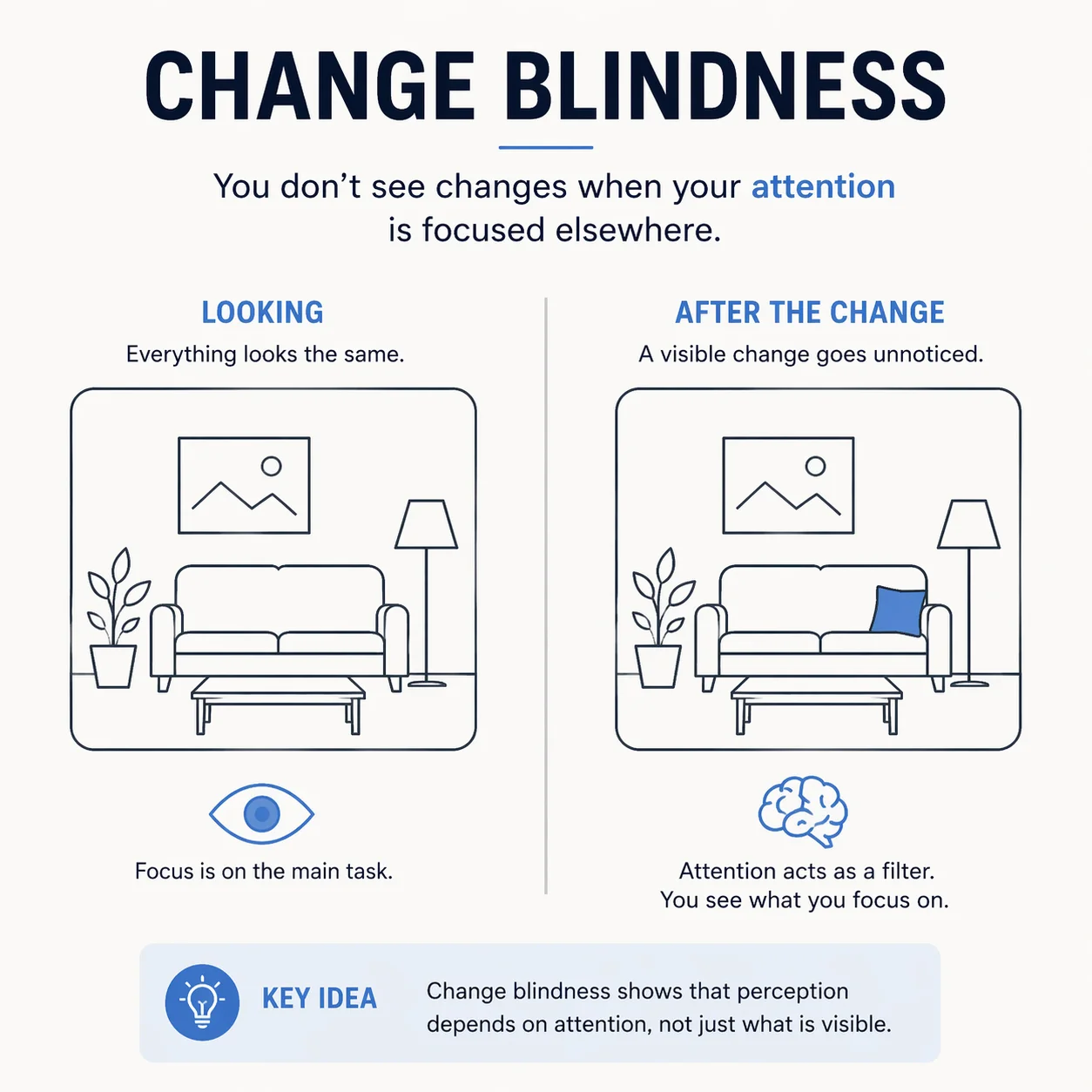
Change blindness refers to the tendency to miss noticeable changes in a visual scene, especially when attention is directed elsewhere.
Even when changes are obvious, they can go undetected if they occur during a brief interruption, distraction, or shift in focus. This reveals that perception is not a continuous recording of reality, but a selective process shaped by attention.
What philosophical idea relates to change blindness?
Change blindness connects to a fundamental philosophical question:
Do people see reality as it is, or only what they attend to?
Philosophical discussions on perception suggest that observation is not purely objective. Instead, it is filtered through attention, expectations, and interpretation.
This leads to a key insight:
What is not attended to is often not perceived.
Is there a simple illustration of change blindness?
Imagine watching a short video where people are passing a ball to each other. The task is to count the number of passes.
While focusing on counting, an unexpected event occurs in the scene. However, many viewers fail to notice it.
The change is visible, yet it goes unnoticed—not because it is hidden, but because attention is directed elsewhere.
This illustrates how perception depends on focus rather than complete visual awareness.
How does psychology explain change blindness?
Psychology explains this phenomenon through the Change Blindness, which shows that attention plays a central role in perception.
Several mechanisms contribute to this effect:
Limited attention capacity
The brain can only process a limited amount of visual information at a time. Attention acts as a filter, selecting what is processed.
Selective focus
When attention is directed toward a specific task, other elements in the environment receive less processing.
Incomplete visual representation
The brain does not store a complete, detailed image of the environment. Instead, it constructs a simplified representation based on what is attended to.
Why do obvious changes go unnoticed?
Obvious changes may go unnoticed because attention is already engaged elsewhere.
When focus is directed toward a specific task, the brain prioritizes relevant information and filters out unrelated details. Changes occurring outside the focus of attention may not be processed fully, even if they are clearly visible.
This demonstrates that visibility does not guarantee awareness.
What does change blindness reveal about perception?
Change blindness shows that perception is selective rather than comprehensive.
Instead of capturing every detail, the brain:
- focuses on relevant information
- filters out less important elements
- constructs a simplified version of reality
This allows efficient processing but also creates gaps in awareness.
How does attention shape what is seen?
Attention determines which parts of the environment are processed in detail.
When attention is focused:
- selected elements become clear and detailed
- unselected elements remain vague or unnoticed
This means perception is guided not only by what is present, but by where attention is directed.
How does change blindness appear in everyday situations?
Change blindness can occur in many everyday contexts:
- overlooking small changes in familiar environments
- missing details while focused on a specific task
- failing to notice alterations during brief distractions
In each case, attention limits what is consciously perceived.
Why is understanding change blindness important?
Understanding change blindness helps explain the limits of human perception.
Psychology shows that:
- attention shapes awareness
- perception is selective
- not all visible information is processed
Recognizing these limits provides a clearer understanding of how people interact with their environment.


Leave a Comment