
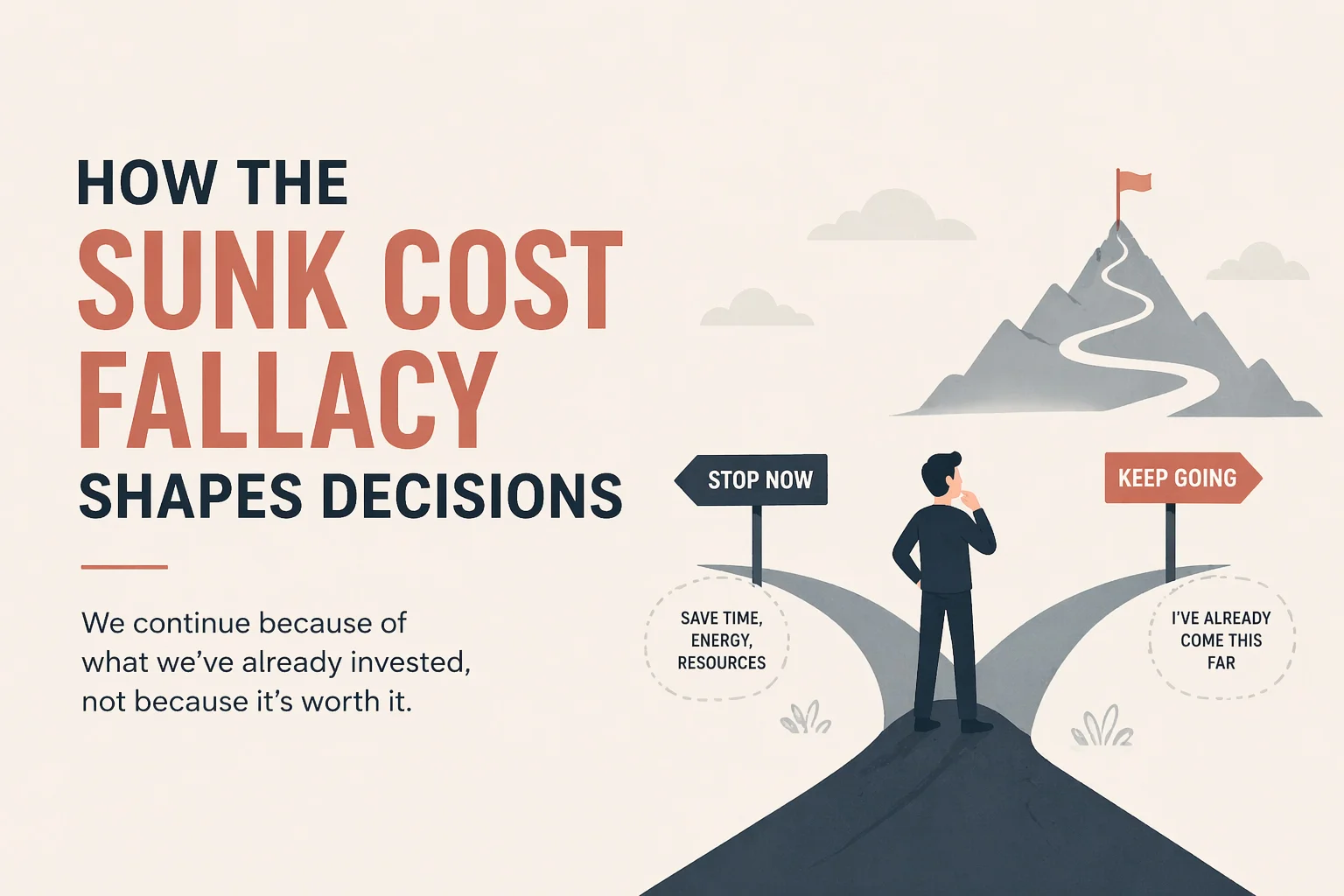
What is the sunk cost fallacy?
The sunk cost fallacy refers to the tendency to continue a decision based on previously invested time, effort, or resources, rather than current conditions.
From a rational perspective, past investments cannot be recovered. Decisions should depend only on present value and future outcomes. However, human decision-making often includes past commitments as a factor, even when they are no longer relevant.
This creates a pattern where individuals continue actions simply because they have already invested in them.
What philosophical idea relates to this pattern?
This behavior reflects a broader philosophical idea: the tension between past attachment and present judgment.
A key question emerges:
Should past actions influence present decisions?
Philosophical reasoning suggests that each decision should stand independently, evaluated based on current reality. However, attachment to prior effort can blur this evaluation.
This highlights a recurring principle:
What has already been spent often shapes how current situations are perceived.
Is there a simple story that illustrates this idea?
A traveler once set out on a long journey toward a distant destination. Along the way, the path became difficult, and the destination no longer seemed worthwhile.
Despite this, the traveler continued.
When asked why, the response was simple:
“I have already come this far.”
The decision was no longer based on whether continuing made sense. Instead, it was shaped by the effort already invested.
This story illustrates how past investment can influence present choices, even when conditions change.
How does psychology explain the sunk cost fallacy?
Psychology explains this behavior through the Sunk Cost Fallacy, a cognitive bias where previous investments affect ongoing decisions.
Several psychological mechanisms contribute to this:
Commitment consistency
Once a decision is made, there is a tendency to remain consistent with that choice.
Loss aversion
People tend to avoid perceived losses. Stopping a decision can feel like accepting that prior investment was lost.
Effort justification
Time and effort already invested increase the perceived value of continuing, even when outcomes are uncertain.
Why do past investments influence current decisions?
Past investments create a mental reference point. Time, effort, or resources become psychologically linked to the value of a decision.
This connection leads to a perception that stopping would invalidate what has already been invested. As a result, individuals may continue investing to maintain consistency with past actions.
However, past investments cannot influence future outcomes. They exist only as prior events, not as factors that determine future value.
How does this appear in everyday situations?
The sunk cost fallacy can be observed in many common situations:
- continuing a task longer than necessary
- sticking with decisions despite changing conditions
- prioritizing past effort over present evaluation
In each case, decisions are influenced by previous investment rather than current benefit.
Why is it difficult to ignore sunk costs?
Ignoring sunk costs requires separating past effort from present evaluation. This can be difficult because:
- past effort feels personally significant
- stopping may feel like inconsistency
- previous decisions create a sense of commitment
These factors make it challenging to reassess situations objectively.
What does this reveal about decision-making?
The sunk cost fallacy shows that decisions are not always based purely on logic. Instead, they are influenced by psychological tendencies that prioritize consistency and past investment.
This demonstrates that human decision-making often includes factors that are not directly related to future outcomes.
Why is understanding the sunk cost fallacy important?
Understanding this concept helps explain why people continue certain actions even when conditions change.
Psychology shows that:
- past investments influence present decisions
- perceived loss affects judgment
- commitment can override objective evaluation
Recognizing these patterns provides insight into how decisions evolve over time.


Leave a Comment