
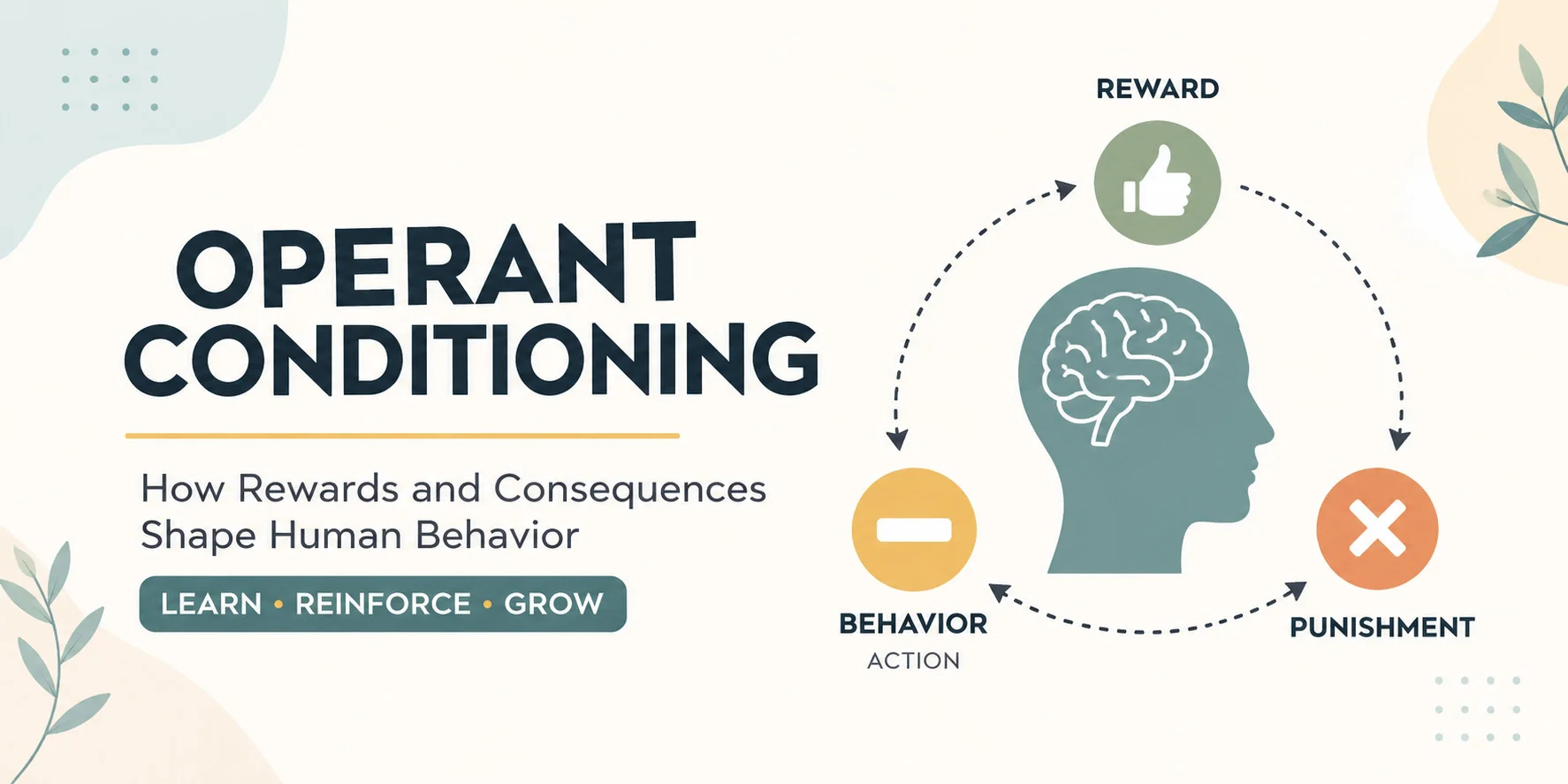
Have you ever noticed that people tend to repeat behaviors that bring good results and avoid behaviors that lead to unpleasant outcomes? This simple idea forms the foundation of Operant Conditioning, one of the most influential learning theories in psychology.
Developed by psychologist B. F. Skinner, Operant Conditioning explains how behavior changes through rewards and consequences. It is widely used in education, parenting, workplaces, sports, healthcare, and even in the apps we use every day.
Let’s explore how this theory works and why it continues to influence human behavior in everyday life.
What is Operant Conditioning?
Operant Conditioning is a learning process in which behavior is influenced by its consequences.
If a behavior leads to something positive, it becomes more likely to happen again. If it leads to something unpleasant or removes something desirable, the behavior becomes less likely to be repeated.
In simple words:
- Good outcome = behavior increases.
- Unpleasant outcome = behavior decreases.
Unlike automatic reflexes, Operant Conditioning focuses on behaviors that people choose to perform.
Who developed Operant Conditioning?
Operant Conditioning was developed by B. F. Skinner, an American psychologist, during the 1930s.
Skinner expanded earlier ideas about learning by showing that consequences play a major role in shaping behavior. His research became one of the foundations of behavioral psychology.
One of his most famous experiments involved the Skinner Box, where animals learned to perform actions like pressing a lever to receive food.
These experiments demonstrated that behavior could be shaped gradually through reinforcement.
How does Operant Conditioning work?
The process is surprisingly simple.
- A person performs a behavior.
- A consequence follows.
- The brain remembers the result.
- Future behavior changes based on that experience.
For example:
A student studies hard for an exam.
They receive excellent grades.
The positive result encourages them to study again in the future.
The reward strengthens the behavior.
What is reinforcement?
Reinforcement increases the likelihood of a behavior happening again.
There are two types.
Positive Reinforcement
Positive reinforcement means adding something pleasant after a behavior.
Examples include:
- Receiving praise after doing a good job.
- Getting a bonus for meeting work goals.
- A child receiving a sticker for finishing homework.
- Earning loyalty points after shopping.
The reward encourages repetition.
Negative Reinforcement
Negative reinforcement often causes confusion.
It does not mean punishment.
Instead, it means removing something unpleasant after the desired behavior.
Examples include:
- Wearing a seatbelt stops the warning alarm.
- Completing assignments early reduces stress.
- Taking an umbrella prevents getting wet in the rain.
The removal of discomfort strengthens the behavior.
What is punishment?
Punishment reduces the likelihood of a behavior happening again.
There are two types.
Positive Punishment
Something unpleasant is added after a behavior.
Examples include:
- Receiving a speeding ticket.
- Extra chores after breaking household rules.
- A warning from a manager for repeated mistakes.
The unpleasant consequence discourages repetition.
Negative Punishment
Something enjoyable is taken away.
Examples include:
- Losing screen time.
- A teenager losing driving privileges.
- A child having a favorite toy temporarily removed.
Removing something desirable decreases the unwanted behavior.
What is shaping?
Sometimes people cannot learn complex behaviors all at once.
Skinner introduced the idea of shaping, where small improvements are rewarded step by step until the desired behavior is achieved.
For example:
A child learning to ride a bicycle first gets praise for balancing.
Later they are rewarded for pedaling.
Eventually they master riding independently.
Small successes build larger achievements.
What are reinforcement schedules?
Rewards do not always need to happen every time.
Psychologists discovered that different reward patterns produce different results.
Continuous reinforcement
Every correct behavior receives a reward.
Best for learning new skills.
Example:
A teacher praises every correct answer.
Partial reinforcement
Only some correct behaviors receive rewards.
This creates stronger long-term habits.
Example:
A salesperson receives occasional bonuses instead of after every sale.
Why are video games and social media so engaging?
Many digital platforms use partial reinforcement.
You never know exactly when you will receive:
- New likes
- New followers
- Rewards
- Rare game items
- Notifications
This uncertainty keeps people checking repeatedly.
The same learning principles explain why many digital experiences feel highly engaging.
What are real-life examples of Operant Conditioning?
Operant Conditioning appears almost everywhere.
In schools
Teachers praise participation.
Students earn certificates.
Good attendance is rewarded.
At work
Employees receive promotions.
Performance bonuses encourage productivity.
Recognition motivates continued effort.
At home
Parents reward helpful behavior.
Children learn household routines.
Positive habits gradually develop.
In fitness
Tracking workout progress motivates consistency.
Small achievements encourage continued exercise.
In pet training
Dogs receive treats for following commands.
Over time, the desired behavior becomes a habit.
What are the advantages of Operant Conditioning?
This learning method has many practical benefits.
- Encourages positive habits.
- Makes learning easier.
- Improves motivation.
- Provides clear feedback.
- Works across different age groups.
- Supports skill development.
- Helps build consistent routines.
Are there any limitations?
Like every psychological theory, Operant Conditioning has limitations.
People are not motivated only by rewards.
Thoughts, emotions, personality, relationships, and personal values also influence behavior.
If rewards stop suddenly, some behaviors may disappear.
External rewards can sometimes reduce internal motivation if they are used too often.
Because of this, psychologists often combine behavioral techniques with other approaches when understanding human behavior.
How is Operant Conditioning different from Classical Conditioning?
Although both explain learning, they work differently.
| Classical Conditioning | Operant Conditioning |
|---|---|
| Learning through association | Learning through consequences |
| Behavior is usually automatic | Behavior is voluntary |
| Developed by Ivan Pavlov | Developed by B. F. Skinner |
| Focuses on stimuli before behavior | Focuses on consequences after behavior |
Both theories remain important in modern psychology.
Can Operant Conditioning help build better habits?
Yes.
Many successful habit-building strategies rely on these principles.
For example:
- Reward yourself after completing a workout.
- Track progress with a checklist.
- Celebrate small milestones.
- Remove distractions after productive behavior.
- Create routines that make success easier.
Small rewards make positive habits easier to maintain over time.
Why is Operant Conditioning still important today?
Nearly every area of modern life uses these principles.
Schools encourage learning through recognition.
Companies motivate employees with rewards.
Fitness apps celebrate achievements.
Online platforms encourage continued engagement.
Parents teach life skills through praise and consequences.
Understanding Operant Conditioning helps explain why people develop habits, stay motivated, and change their behavior over time.
Final Thoughts
Operant Conditioning reminds us that behavior is shaped by consequences. Positive experiences encourage actions to continue, while unpleasant outcomes make behaviors less likely to happen again.
Whether you are raising children, teaching students, managing employees, building healthy habits, or simply trying to understand yourself better, this theory provides valuable insight into why people do what they do.
When used thoughtfully, positive reinforcement can become a powerful tool for encouraging growth, learning, and lasting behavior change.
Frequently Asked Questions
Is Operant Conditioning still used today?
Yes. It is widely used in education, parenting, healthcare, business, sports coaching, and behavior training.
Who created Operant Conditioning?
Psychologist B. F. Skinner developed the theory through extensive research on learning and behavior.
What is the main idea of Operant Conditioning?
Behavior is influenced by its consequences. Rewards increase behavior, while punishment reduces it.
What is the difference between reinforcement and punishment?
Reinforcement encourages behavior to continue, while punishment aims to reduce unwanted behavior.
Can adults learn through Operant Conditioning?
Absolutely. Adults continue to learn from rewards, feedback, and consequences throughout life.
Key Takeaways
- Operant Conditioning explains how consequences shape behavior.
- Positive reinforcement strengthens desired actions.
- Negative reinforcement removes unpleasant experiences to encourage behavior.
- Punishment reduces unwanted behavior.
- Small rewards can build long-term habits.
- The theory remains widely used in education, parenting, workplaces, and daily life.


Leave a Comment