
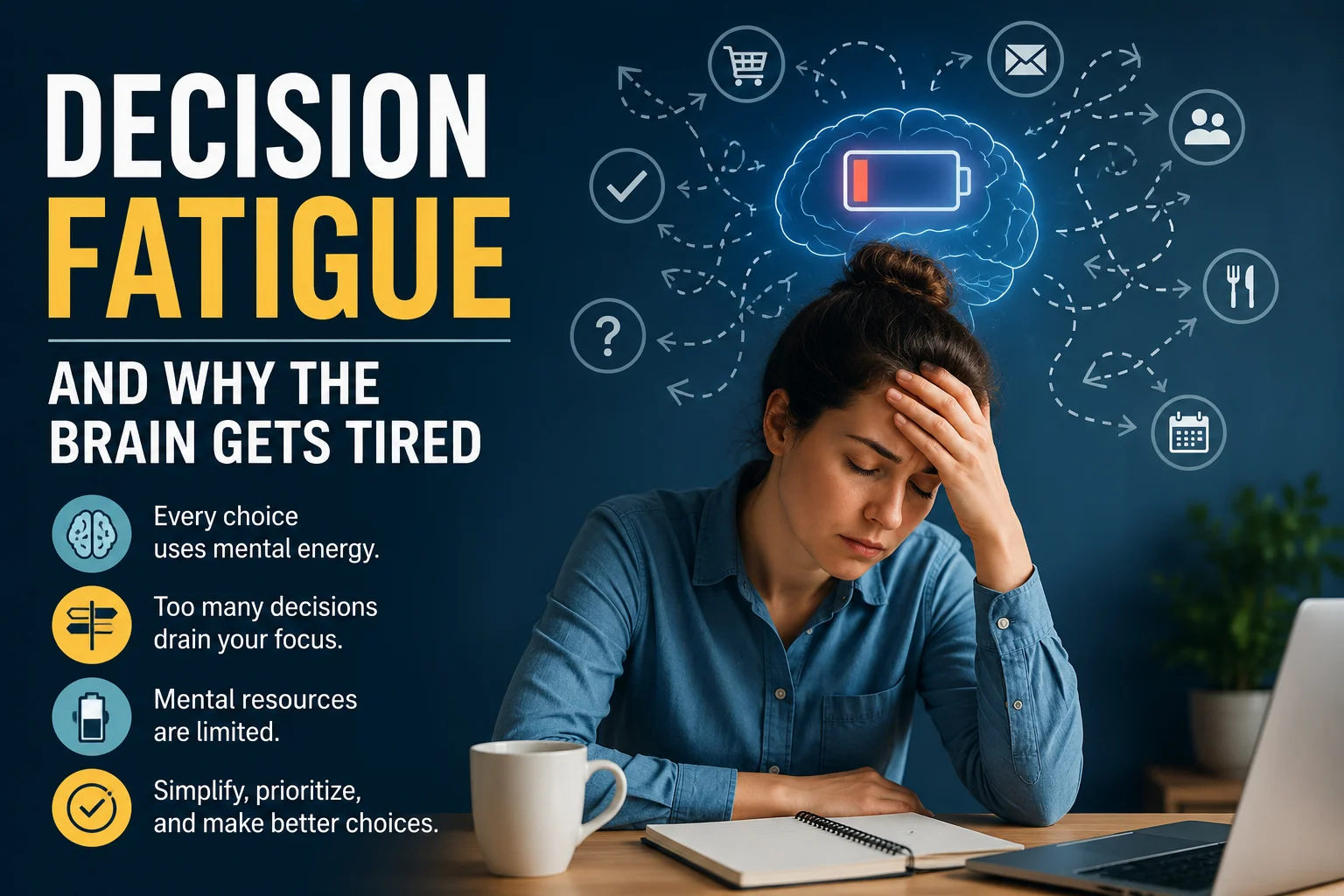
What Is Decision Fatigue?
Decision fatigue refers to the decline in the quality of decisions after an individual has made many choices over an extended period. As the brain continuously evaluates options, weighs consequences, and suppresses alternatives, mental resources become depleted. This exhaustion can make even simple decisions feel overwhelming.
Many people assume physical work is the primary source of tiredness, but cognitive effort can be equally demanding. Every decision—whether choosing clothing, responding to emails, selecting meals, or making financial choices—requires mental processing. Over time, the accumulation of these choices can drain attention, self-control, and judgment.
Decision fatigue is not a medical condition. Instead, it is a psychological phenomenon that explains why decision-making often becomes more difficult as the day progresses.
Why Does the Brain Become Tired from Making Decisions?
The human brain is designed to conserve energy whenever possible. Decision-making involves several cognitive functions, including attention, memory, reasoning, and self-regulation. These processes rely heavily on the prefrontal cortex, the region responsible for executive functioning.
When numerous decisions are made in succession, the brain experiences:
- Reduced mental energy
- Decreased concentration
- Lower self-control
- Increased impulsivity
- Greater reliance on shortcuts and habits
As cognitive resources become strained, the brain seeks ways to reduce effort. This often leads to avoidance, procrastination, impulsive choices, or reliance on default options.
Research suggests that mental fatigue influences how individuals process information, evaluate risks, and regulate emotions. The more complex the decisions, the greater the cognitive demand.
How Is Decision Fatigue Different from Regular Fatigue?
Physical fatigue results from bodily exertion and lack of rest. Decision fatigue specifically affects cognitive performance and judgment.
Someone experiencing decision fatigue may:
- Feel mentally exhausted despite being physically rested
- Struggle to make simple choices
- Delay important decisions
- Choose the easiest option rather than the best one
- Experience frustration when confronted with additional choices
Unlike general tiredness, decision fatigue primarily impacts the quality of thinking rather than physical capability.
What Happens in the Brain During Decision Fatigue?
Every decision requires the brain to evaluate possibilities, predict outcomes, and suppress competing alternatives. This process places significant demands on executive functions.
When decision fatigue develops, several changes may occur:
Reduced Executive Control
The brain becomes less effective at managing competing information and maintaining focus.
Increased Reliance on Cognitive Shortcuts
Instead of carefully analyzing options, people often depend on mental shortcuts known as heuristics.
Impaired Self-Regulation
Resisting temptations and controlling impulses becomes more difficult.
Greater Emotional Influence
Decisions become increasingly driven by emotions rather than careful reasoning.
Reduced Motivation
Even routine choices may begin to feel burdensome.
These effects collectively contribute to poorer decision quality over time.
What Are Common Signs of Decision Fatigue?
Decision fatigue can manifest in many ways.
Common indicators include:
- Indecisiveness
- Mental exhaustion
- Irritability
- Procrastination
- Avoidance of important tasks
- Increased impulsive behavior
- Difficulty concentrating
- Preference for default choices
- Reduced patience
- Feeling overwhelmed by minor decisions
These symptoms often become more noticeable later in the day when cognitive resources have been repeatedly taxed.
Can Everyday Choices Really Exhaust Mental Resources?
Yes. Modern life presents individuals with an unprecedented number of daily decisions.
Examples include:
- Choosing what to wear
- Selecting meals
- Managing social media interactions
- Responding to messages
- Shopping decisions
- Scheduling activities
- Evaluating information online
- Managing finances
Although each choice may seem insignificant, their cumulative effect can create substantial mental strain.
Researchers estimate that people make thousands of decisions every day, many occurring automatically without conscious awareness.
Why Do Important Decisions Often Feel Harder Later in the Day?
Decision-making capacity tends to decline after prolonged periods of cognitive effort.
As mental resources diminish:
- Attention becomes less stable
- Information processing slows
- Risk assessment becomes less accurate
- Impulse control weakens
This helps explain why individuals may make healthier, more thoughtful decisions in the morning but struggle to maintain the same standards later.
Many organizations schedule critical meetings, strategic planning sessions, and evaluations earlier in the day to capitalize on higher cognitive performance.
How Does Decision Fatigue Affect Self-Control?
Self-control and decision-making share overlapping cognitive resources.
When people repeatedly exert self-control throughout the day, they may experience:
- Reduced resistance to temptations
- Increased emotional reactions
- Poor dietary choices
- Overspending
- Reduced persistence on challenging tasks
For example, an individual who spends hours making complex work-related decisions may find it harder to resist unhealthy snacks or impulsive purchases later.
The brain tends to favor immediate rewards when mental resources are depleted.
Does Decision Fatigue Influence Consumer Behavior?
Decision fatigue plays a major role in purchasing behavior.
When consumers become mentally exhausted, they are more likely to:
- Buy impulsively
- Accept default recommendations
- Avoid comparing alternatives
- Choose familiar products
- Spend more than intended
Retail environments often present numerous options, discounts, and promotions, which can further increase cognitive load.
As decision fatigue increases, consumers may prioritize convenience over careful evaluation.
How Does Technology Contribute to Decision Fatigue?
Digital environments expose people to a constant stream of choices.
Examples include:
- Notifications
- Emails
- Social media content
- Streaming recommendations
- Online shopping options
- News consumption
Every interaction requires attention and micro-decisions. Although each decision appears minor, the cumulative effect can create significant cognitive strain.
The abundance of choices available through technology has become one of the major contributors to modern decision fatigue.
What Is the Relationship Between Choice Overload and Decision Fatigue?
Choice overload occurs when individuals face too many options.
While having options can be beneficial, excessive choice often leads to:
- Increased anxiety
- Decision delays
- Reduced satisfaction
- Greater mental effort
Choice overload accelerates decision fatigue because the brain must evaluate more information and compare additional alternatives.
Research consistently shows that people often experience greater satisfaction when presented with a manageable number of meaningful choices rather than an overwhelming selection.
Who Is Most Vulnerable to Decision Fatigue?
Anyone can experience decision fatigue, but certain groups may be particularly susceptible.
These include:
- Business leaders
- Healthcare professionals
- Educators
- Caregivers
- Entrepreneurs
- Managers
- Students during examination periods
- Individuals facing major life transitions
People whose roles require frequent judgment and problem-solving often experience greater cognitive demands throughout the day.
How Can People Reduce Decision Fatigue?
Several practical strategies can help preserve mental resources.
Create Routines
Routine behaviors reduce the number of daily decisions.
Prioritize Important Decisions
Schedule significant decisions during periods of peak mental alertness.
Limit Unnecessary Choices
Simplifying everyday decisions conserves cognitive energy.
Use Checklists
Checklists reduce mental load and improve consistency.
Organize the Environment
An organized environment minimizes decision demands.
Take Strategic Breaks
Short breaks can help restore attention and mental clarity.
Automate Repetitive Tasks
Automation reduces the need for repeated decision-making.
Manage Digital Distractions
Reducing notifications and information overload decreases cognitive burden.
Can Rest Restore Decision-Making Ability?
Rest is one of the most effective ways to recover cognitive resources.
Sleep plays a particularly important role in:
- Memory consolidation
- Emotional regulation
- Attention restoration
- Executive functioning
Adequate sleep improves decision quality and helps replenish the mental resources required for self-control and reasoning.
Regular recovery periods throughout the day can also help maintain cognitive performance.
What Can Decision Fatigue Teach Us About Human Behavior?
Decision fatigue demonstrates that human judgment is not unlimited. Even highly intelligent and disciplined individuals operate within cognitive constraints.
The phenomenon highlights several important psychological principles:
- Mental resources are finite.
- Self-control requires effort.
- Environment influences behavior.
- Simplicity can improve decision quality.
- Cognitive performance fluctuates throughout the day.
Understanding these limitations can help individuals design routines, environments, and habits that support better decisions while reducing unnecessary mental strain.
Conclusion
Decision fatigue is a powerful psychological phenomenon that reveals how repeated decision-making can gradually drain mental resources. As cognitive energy declines, individuals become more vulnerable to impulsive choices, procrastination, and poor judgment. In a world filled with constant options and digital distractions, understanding decision fatigue has become increasingly important.
By simplifying routine choices, prioritizing important decisions, managing information overload, and allowing adequate recovery, individuals can preserve mental energy and improve the quality of their decisions. Recognizing the limits of cognitive resources is not a sign of weakness—it is an essential step toward making smarter, more effective choices in everyday life.


Leave a Comment