
You have exactly 7 seconds. That’s all the time you get to make a first impression that could shape someone’s perception of you for months, or even years. But what exactly happens in those crucial moments when two people meet? The psychology of first impressions reveals a complex interplay of cognitive biases, evolutionary programming, and social conditioning that occurs faster than conscious thought.
Recent research in social psychology has uncovered surprising truths about how we form judgments about others—and how remarkably difficult these snap decisions are to change. Understanding these psychological mechanisms can transform how you navigate social situations, build relationships, and present yourself to the world.
The Lightning Speed of Human Judgment
Fact 1: We Form Impressions in 100 Milliseconds
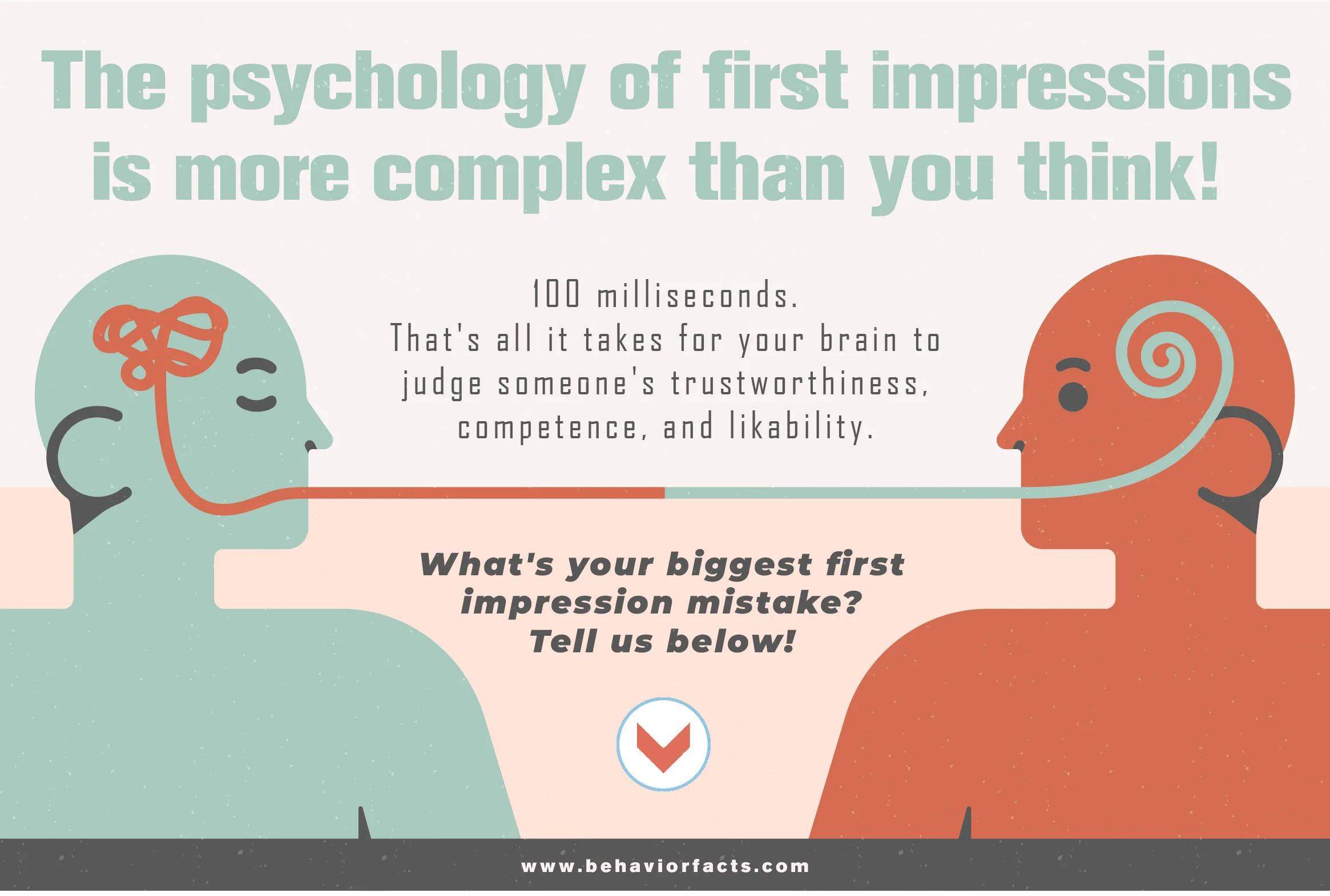
Research conducted at Princeton University revealed that people form impressions about others’ trustworthiness, competence, and likability in just 100 milliseconds—faster than the blink of an eye. Dr. Alexander Todorov’s groundbreaking studies showed that participants could accurately predict election outcomes based solely on candidates’ faces after viewing them for a tenth of a second.
This rapid judgment system exists because our brains are evolutionarily wired for quick threat assessment. In prehistoric times, the ability to instantly categorize strangers as friend or foe was literally a matter of life and death. Today, this same neural machinery operates in boardrooms, coffee shops, and dating apps.
Practical Application: Since first impressions form instantaneously, focus on the basics: maintain good posture, make appropriate eye contact, and ensure your appearance aligns with the context. These elements register before you even speak.
Fact 2: Visual Cues Dominate Initial Judgments
The famous “55-38-7 rule” from psychologist Albert Mehrabian’s research indicates that 55% of communication impact comes from body language, 38% from tone of voice, and only 7% from actual words. While this ratio specifically applies to situations involving emotional content, it highlights how heavily we rely on non-verbal cues when forming impressions.
Facial expressions, posture, clothing choices, and even the way someone walks contribute more to first impressions than the content of their initial words. This visual dominance occurs because our brains process images approximately 60,000 times faster than text, making visual information the primary source of immediate judgment.
Practical Application: Pay attention to your non-verbal communication. A genuine smile, confident posture, and appropriate dress for the situation communicate competence and approachability before any conversation begins.
The Persistence Problem
Fact 3: First Impressions Are Remarkably Sticky
Perhaps the most surprising finding in first impression research is how resistant these initial judgments are to change. The “primacy effect,” first identified by psychologist Solomon Asch in the 1940s, demonstrates that information encountered first carries disproportionate weight in our overall evaluation of someone.
Studies show that even when presented with contradictory evidence, people tend to interpret new information through the lens of their initial impression. If someone seems untrustworthy at first glance, subsequent honest behavior might be dismissed as an act or exception rather than evidence of genuine character.
This persistence exists because of confirmation bias—our tendency to seek information that confirms our existing beliefs while ignoring contradictory evidence. Once we’ve categorized someone, our brains work to maintain that categorization for cognitive efficiency.
Practical Application: Recognize that overcoming a negative first impression requires consistent, repeated positive interactions. Don’t expect one good conversation to completely reverse an initial poor impression.
Fact 4: We Judge Competence from Facial Structure
Research reveals that we make assumptions about someone’s competence based on their facial structure alone. People with wider faces are perceived as more competent and leadership-oriented, while those with more mature-looking faces (larger noses, smaller eyes, pronounced cheekbones) are viewed as more competent than baby-faced individuals.
These judgments occur automatically and unconsciously. In political elections, candidates with more “competent-looking” faces win approximately 70% of the time, even when voters claim physical appearance doesn’t influence their decisions.
This phenomenon stems from evolutionary psychology. Throughout human history, physical markers often correlated with actual abilities—broader faces indicated higher testosterone levels and potential leadership qualities, while mature facial features suggested experience and wisdom.
Practical Application: While you can’t change your facial structure, you can influence how others perceive your competence through confident body language, direct eye contact, and speaking with clarity and conviction.
The Hidden Biases
Fact 5: Height Significantly Impacts Perceived Authority
Taller individuals are consistently perceived as more competent, intelligent, and leadership-oriented. This “height premium” is so strong that each additional inch of height correlates with approximately $789 in additional annual income. CEOs of Fortune 500 companies are on average 2.5 inches taller than the general population.
The psychology behind height bias relates to our evolutionary past, where physical size often indicated strength and survival capability. Modern research shows that we unconsciously associate height with dominance and competence, even in contexts where physical stature has no practical relevance.
Practical Application: If you’re shorter than average, focus on other dominance cues like confident posture, firm handshakes, and speaking with authority. Taller individuals should be mindful not to use their height advantage to intimidate others.
Fact 6: Similarity Breeds Instant Likability
We instinctively prefer people who are similar to us—a phenomenon psychologists call “similarity attraction.” This preference extends beyond obvious characteristics like race and gender to include subtle factors like speaking patterns, clothing styles, posture, and even the speed at which someone talks.
Mirror neurons in our brains activate when we observe others exhibiting behaviors similar to our own, creating an unconscious sense of connection and trust. This similarity bias is so strong that we rate people more favorably when they simply share our first name or birthday.
Practical Application: Subtly mirror the communication style and energy level of people you meet. If someone speaks slowly and thoughtfully, match their pace. If they’re enthusiastic and expressive, adjust your energy accordingly.
The Emotional Factor
Fact 7: Emotional State Colors Every Impression
Your emotional state when meeting someone significantly influences the impression you form of them. Happy people rate others more positively, while those in negative moods tend to form more critical judgments. This “mood congruence effect” means the same person could be perceived entirely differently depending on the observer’s emotional state.
Research shows that people in positive moods pay more attention to positive traits in others, while negative moods heighten focus on potential flaws or threats. This emotional coloring happens unconsciously and affects not just initial impressions but also memory formation about the encounter.
Practical Application: Try to approach new social situations in a positive emotional state. If you’re feeling down, be aware that your mood might be negatively biasing your impressions of others. Similarly, creating positive emotions in others (through humor, compliments, or shared positive experiences) can improve the impressions they form of you.
Mastering the Psychology of First Impressions
Understanding these psychological principles empowers you to navigate social situations more effectively. Remember that first impressions are not destiny—they can be changed, but it requires awareness, patience, and consistent positive interactions.
The next time you meet someone new, remember that both of you are engaging in this rapid, unconscious evaluation process. By being mindful of these psychological mechanisms, you can present your best self while also giving others the grace to move beyond their initial impressions.
The goal isn’t to manipulate others but to understand the fundamental psychology of human connection. In a world where first impressions matter more than ever—from job interviews to dating apps—this knowledge becomes a valuable tool for building genuine relationships and achieving your personal and professional goals.
Remember: While understanding first impression psychology can improve your social interactions, genuine character and authentic relationships develop over time through consistent behavior and mutual respect.

Leave a Comment