
What Is Cognitive Dissonance?
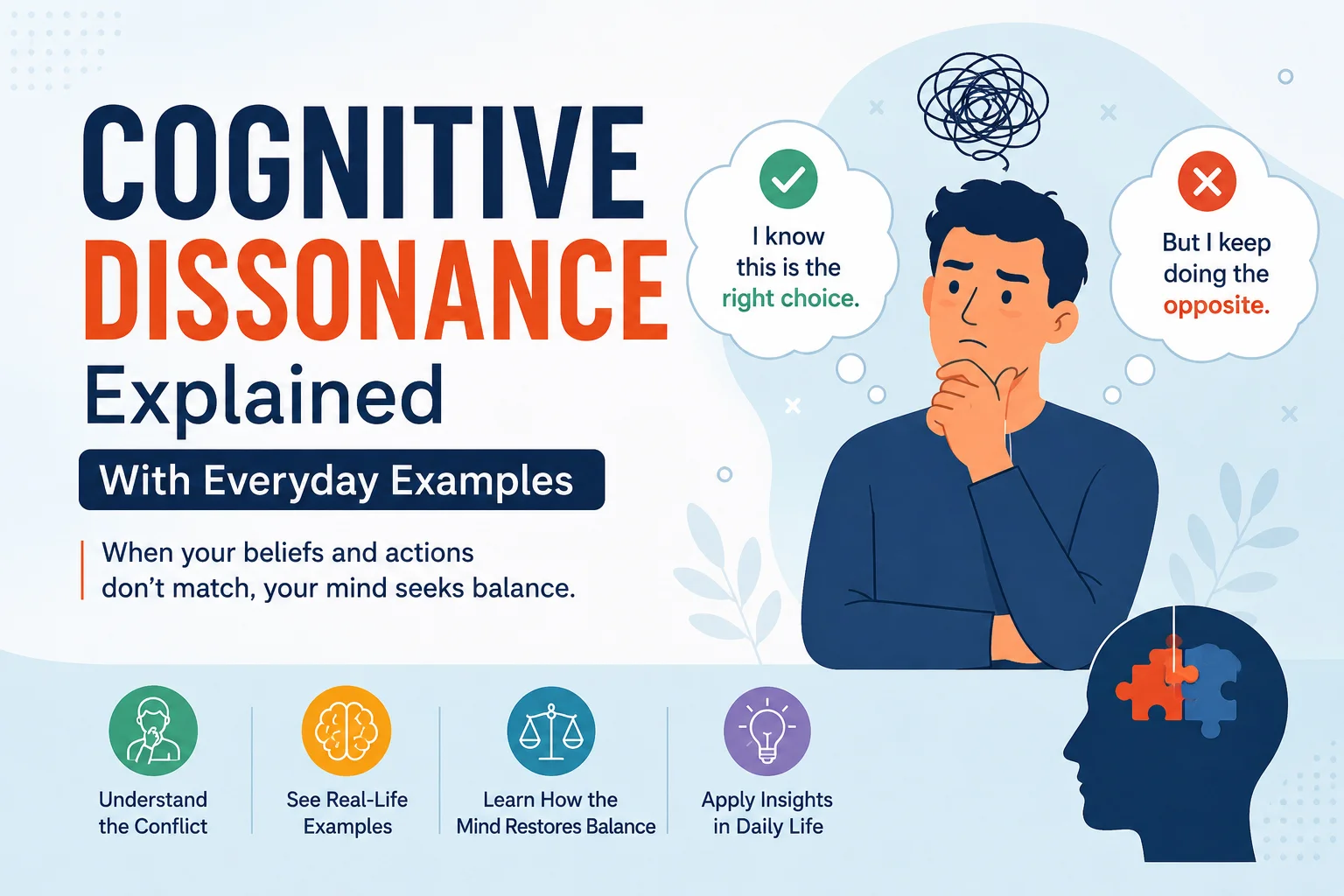
Cognitive dissonance is the mental discomfort people experience when their thoughts, beliefs, attitudes, or behaviors contradict one another. Instead of feeling comfortable with conflicting ideas, the brain naturally tries to reduce the tension by changing beliefs, changing behavior, or finding a way to justify the inconsistency.
For example, someone who knows smoking is harmful but continues to smoke may experience cognitive dissonance. To reduce the discomfort, they might decide to quit, or they may convince themselves that the health risks are exaggerated.
Quick Facts
| Fact | Description |
|---|---|
| Developed by | Leon Festinger |
| Introduced | 1957 |
| Field | Social Psychology |
| Main Idea | People seek consistency between their beliefs and actions. |
| Why It Matters | It influences decision-making, habits, relationships, and consumer behavior. |
What Is Cognitive Dissonance?
Imagine believing that regular exercise is important while rarely exercising yourself. This inconsistency creates psychological discomfort.
The brain dislikes contradictions because they challenge how we see ourselves. Most people want to believe they are rational and make good decisions. When actions conflict with beliefs, the brain works to restore consistency.
This discomfort is called cognitive dissonance.
Why Does Cognitive Dissonance Happen?
Cognitive dissonance usually appears when there is a conflict between:
- Beliefs and behavior
- Attitudes and decisions
- Values and actions
- Expectations and reality
The stronger the conflict, the greater the psychological discomfort.
Everyday Examples of Cognitive Dissonance
Smoking Despite Health Risks
A person understands that smoking increases the risk of disease but continues smoking.
Possible response:
“I’ve smoked for years and I’m still healthy.”
This reduces the discomfort without changing the behavior.
Buying an Expensive Product
Someone spends a large amount of money on a new phone.
After noticing small problems, they tell themselves:
“It was still the best choice.”
This helps justify the purchase.
Staying in an Unhealthy Relationship
A person believes they deserve respect but remains in a relationship where they are treated poorly.
To reduce discomfort, they may think:
“They’ll change.”
Ignoring Exercise
Someone believes exercise is important but avoids working out.
Instead of changing their routine, they might say:
“I’m too busy right now.”
Supporting a Favorite Brand
A loyal customer learns about unethical business practices but continues buying from the company.
They may focus only on positive information while ignoring the negative details.
How People Reduce Cognitive Dissonance
People often reduce cognitive dissonance in five ways.
1. Change Their Behavior
The healthiest solution.
Example:
A smoker decides to quit.
2. Change Their Beliefs
Instead of changing behavior, people may change how they think.
Example:
“Smoking isn’t as dangerous as people say.”
3. Justify the Decision
People convince themselves their choice was reasonable.
Example:
“I worked hard, so I deserved this expensive purchase.”
4. Ignore Conflicting Information
People avoid information that increases discomfort.
Example:
Not reading articles about the risks of smoking.
5. Add Supporting Beliefs
People create new beliefs that make the conflict feel smaller.
Example:
“I exercise regularly, so smoking won’t affect me as much.”
Why Cognitive Dissonance Matters
Understanding cognitive dissonance helps explain many everyday behaviors.
Decision-Making
People often defend decisions after making them.
Relationships
Individuals sometimes remain in unhealthy situations because leaving would challenge previous choices.
Consumer Behavior
Businesses understand that customers often justify purchases after buying.
Workplace
Employees may continue supporting ineffective processes because admitting they are wrong feels uncomfortable.
Health
People may delay healthy habits even when they know the benefits.
Is Cognitive Dissonance Always Bad?
No.
In many situations, cognitive dissonance encourages positive change.
Recognizing inconsistency between beliefs and actions can motivate people to:
- Develop healthier habits
- Improve relationships
- Learn from mistakes
- Make better decisions
- Become more self-aware
Rather than avoiding discomfort, people can use it as an opportunity for growth.
How to Manage Cognitive Dissonance
If you notice conflicting thoughts or behaviors, these strategies can help:
- Be honest with yourself about the conflict.
- Ask why the inconsistency exists.
- Focus on facts instead of assumptions.
- Accept that changing your mind is a sign of learning.
- Make small behavioral changes rather than expecting perfection.
The goal is not to eliminate discomfort completely but to respond to it constructively.
Frequently Asked Questions
Who developed cognitive dissonance theory?
Psychologist Leon Festinger introduced Cognitive Dissonance Theory in 1957.
Is cognitive dissonance normal?
Yes. Almost everyone experiences cognitive dissonance at some point in life.
Can cognitive dissonance be positive?
Yes. It often motivates people to change unhealthy behaviors and make better decisions.
What is the difference between cognitive dissonance and hypocrisy?
Hypocrisy involves knowingly acting against stated beliefs. Cognitive dissonance refers to the psychological discomfort that may arise from such inconsistencies.
Does cognitive dissonance affect decision-making?
Yes. It can influence how people justify choices, evaluate information, and respond to new evidence.
Key Takeaways
- Cognitive dissonance is the discomfort caused by conflicting thoughts, beliefs, or actions.
- The brain naturally tries to reduce this discomfort.
- People often reduce dissonance by changing behavior, changing beliefs, or justifying decisions.
- Everyday situations such as shopping, relationships, health, and work commonly involve cognitive dissonance.
- Recognizing cognitive dissonance can lead to healthier choices and greater self-awareness.
Conclusion
Cognitive dissonance is a normal part of human psychology. Everyone experiences moments when beliefs and actions do not perfectly align. Rather than viewing this discomfort as a weakness, it can be seen as an opportunity to reflect, learn, and grow. By becoming aware of these internal conflicts, people can make more thoughtful decisions and gradually align their behaviors with their values.


Leave a Comment