
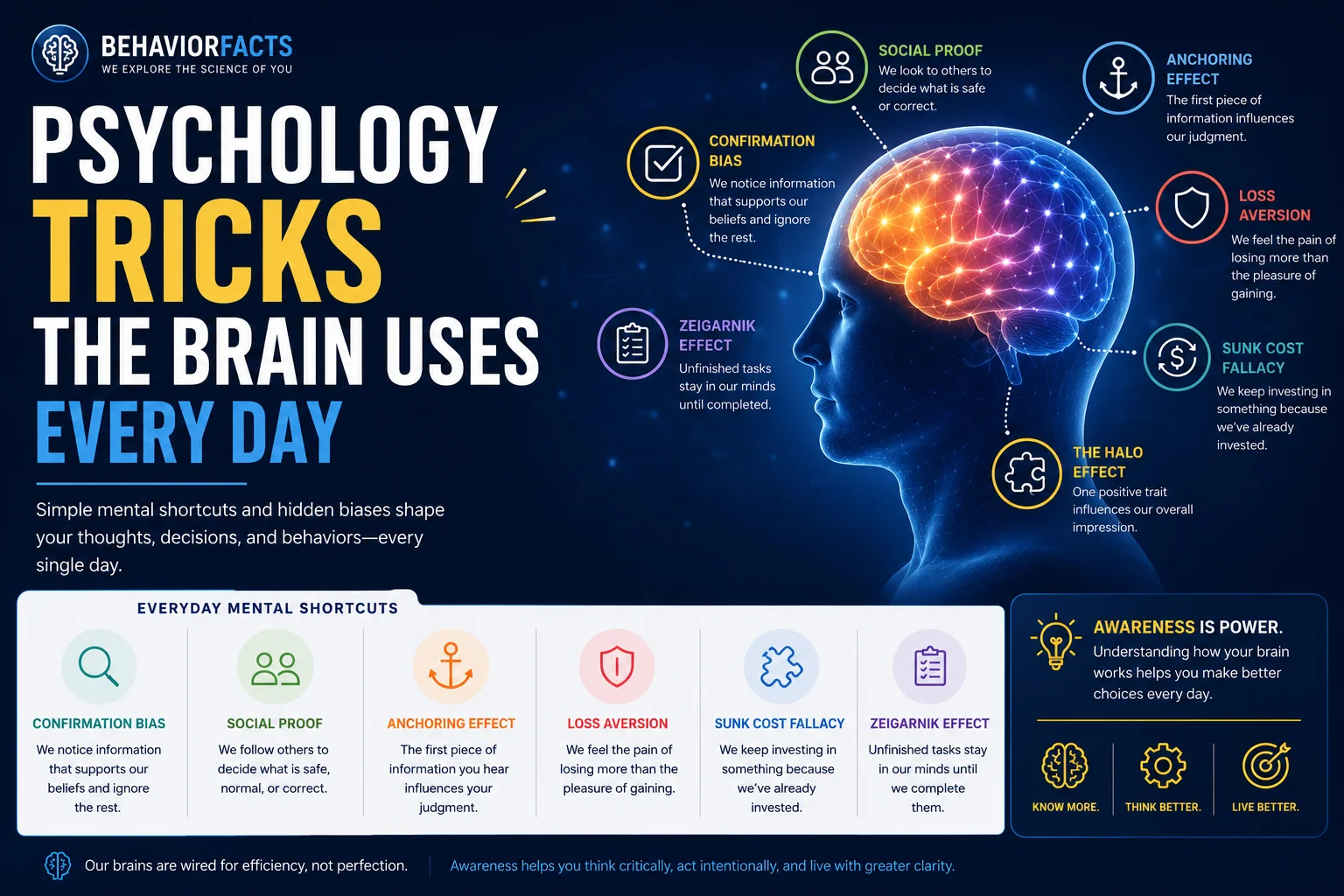
Human behavior often feels deliberate and rational, yet much of daily decision-making happens automatically. The brain constantly uses mental shortcuts, unconscious biases, and cognitive mechanisms to simplify complex information and conserve energy. These psychological tricks are not necessarily flaws. In many situations, they help people navigate the world efficiently. However, they can also influence judgments, choices, relationships, and perceptions without conscious awareness.
Understanding these everyday psychological tricks provides valuable insight into how the mind operates and why people sometimes think, feel, and behave in unexpected ways.
What are psychological tricks of the brain?
Psychological tricks are automatic mental processes that help the brain interpret information, make decisions, and respond quickly to situations. Rather than analyzing every detail, the brain relies on shortcuts known as heuristics and cognitive biases.
These mechanisms evolved because the human brain processes enormous amounts of information every second. Without shortcuts, everyday tasks would become mentally exhausting.
Many psychological tricks occur outside conscious awareness, making them powerful influences on behavior.
Why does the brain rely on mental shortcuts?
The brain has limited cognitive resources. Processing every piece of information in a detailed and analytical way would require significant energy and time.
Mental shortcuts help by:
- Reducing decision-making effort
- Increasing processing speed
- Conserving mental energy
- Helping individuals react quickly
- Simplifying complex environments
Although these shortcuts are efficient, they can occasionally lead to inaccurate conclusions or biased judgments.
How does the confirmation bias trick influence thinking?
Confirmation bias occurs when people naturally seek information that supports existing beliefs while overlooking contradictory evidence.
For example, someone who believes a particular diet is highly effective may focus on success stories while ignoring scientific findings that suggest mixed results.
This bias can influence:
- Political opinions
- Health decisions
- Consumer choices
- Social judgments
- Workplace evaluations
Because confirmation bias operates automatically, people often assume they are evaluating information objectively even when selective attention is occurring.
What is the halo effect and why is it so powerful?
The halo effect happens when one positive characteristic creates an overall favorable impression of a person, product, or organization.
For example, an attractive individual may be perceived as more intelligent, trustworthy, or competent even without evidence supporting those assumptions.
The halo effect influences:
- Job interviews
- Marketing campaigns
- Leadership evaluations
- Educational settings
- Social relationships
This mental shortcut helps the brain make quick judgments, but it can also create inaccurate impressions.
How does the brain create first impressions so quickly?
Research suggests that first impressions form within seconds of meeting someone. The brain rapidly evaluates facial expressions, body language, voice tone, and contextual cues.
These quick assessments helped human survival by enabling fast decisions about potential threats or allies.
While first impressions can sometimes be accurate, they are also vulnerable to biases and stereotypes. Once formed, they often become difficult to change because the brain tends to seek consistency.
Why do people remember unfinished tasks better than completed ones?
This phenomenon is known as the Zeigarnik Effect.
The brain tends to keep incomplete goals active in memory. Unfinished tasks create psychological tension that remains until completion.
Examples include:
- Remembering pending assignments
- Thinking about unresolved conversations
- Recalling incomplete projects
- Feeling mentally occupied by unfinished responsibilities
This effect explains why people often find it difficult to relax when important tasks remain unfinished.
How does social proof influence behavior?
Social proof occurs when people look to others for guidance about what is appropriate or correct.
Examples include:
- Choosing a crowded restaurant over an empty one
- Purchasing highly rated products
- Following popular trends
- Trusting recommendations from large groups
The brain assumes that if many people are making a particular choice, the choice is likely safe or beneficial.
While social proof can be helpful, it may also contribute to herd behavior and poor group decisions.
What is the anchoring effect?
The anchoring effect occurs when the first piece of information encountered influences later judgments.
For instance, seeing a product originally priced at $1,000 and discounted to $700 can make the discount appear more attractive because the initial price serves as an anchor.
Anchoring affects:
- Shopping decisions
- Salary negotiations
- Real estate pricing
- Financial judgments
- Risk assessments
Even arbitrary numbers can influence subsequent evaluations without conscious awareness.
Why does the brain fear losses more than it values gains?
This psychological tendency is known as loss aversion.
Research has shown that the emotional impact of losing something is often stronger than the pleasure associated with gaining something of equal value.
Examples include:
- Holding onto poor investments
- Avoiding beneficial risks
- Hesitating to change careers
- Reluctance to discard unused possessions
Loss aversion can be adaptive because it encourages caution, but it may also prevent growth and opportunity.
How does repetition trick the brain into believing information?
The Illusory Truth Effect occurs when repeated information feels more believable over time.
Repeated statements become easier for the brain to process, and this familiarity is often mistaken for accuracy.
This effect can influence:
- Advertising effectiveness
- Brand recognition
- Political messaging
- Social media content
- Public opinion formation
Familiarity does not guarantee truth, yet the brain frequently treats familiar information as more trustworthy.
Why do people continue investing in bad decisions?
The sunk cost effect explains why individuals persist with unsuccessful choices after investing time, money, or effort.
Examples include:
- Finishing a boring movie
- Remaining in an unproductive project
- Continuing a failing business strategy
- Staying committed to ineffective plans
The brain dislikes acknowledging losses and often focuses on past investments rather than future outcomes.
This tendency can lead to prolonged commitment even when better alternatives exist.
How does the brain fill in missing information?
The brain constantly predicts and interprets incoming information. When details are incomplete, it often fills gaps automatically.
This process helps people:
- Read partially obscured words
- Recognize familiar faces
- Understand fragmented conversations
- Navigate uncertain situations
Although this predictive ability improves efficiency, it can also contribute to misunderstandings and false assumptions.
Why do emotional experiences feel more memorable?
Emotions act as powerful memory enhancers.
Events associated with strong emotions often receive greater attention and deeper processing, making them easier to remember.
Examples include:
- Significant life milestones
- Embarrassing moments
- Personal achievements
- Unexpected surprises
The brain prioritizes emotionally meaningful information because it may have survival value.
How does the availability heuristic affect judgment?
The availability heuristic occurs when people estimate likelihood based on how easily examples come to mind.
For instance, after hearing extensive news coverage about airplane accidents, individuals may overestimate the danger of flying despite statistical evidence showing it is relatively safe.
This shortcut influences perceptions of:
- Risk
- Safety
- Crime
- Health threats
- Financial decisions
The ease of recalling information often outweighs objective probability.
Can these psychological tricks be controlled?
Completely eliminating cognitive shortcuts is neither realistic nor desirable. These mechanisms help people function efficiently in everyday life.
However, awareness can reduce their influence.
Helpful strategies include:
- Questioning initial assumptions
- Seeking alternative viewpoints
- Evaluating evidence objectively
- Slowing important decisions
- Reflecting on emotional reactions
Recognizing psychological tricks allows individuals to make more informed and balanced choices.
What can be learned from these everyday brain tricks?
The brain is remarkably efficient, but efficiency sometimes comes at the cost of accuracy. Psychological shortcuts shape perceptions, beliefs, decisions, and behaviors every day.
Understanding these mental processes helps explain why people occasionally make irrational choices, misjudge situations, or follow patterns they do not fully understand.
Rather than viewing these psychological tricks as weaknesses, they can be seen as evidence of the brain’s ongoing effort to manage complexity. Awareness of these mechanisms provides a valuable foundation for better decision-making, critical thinking, and self-understanding.


Leave a Comment