
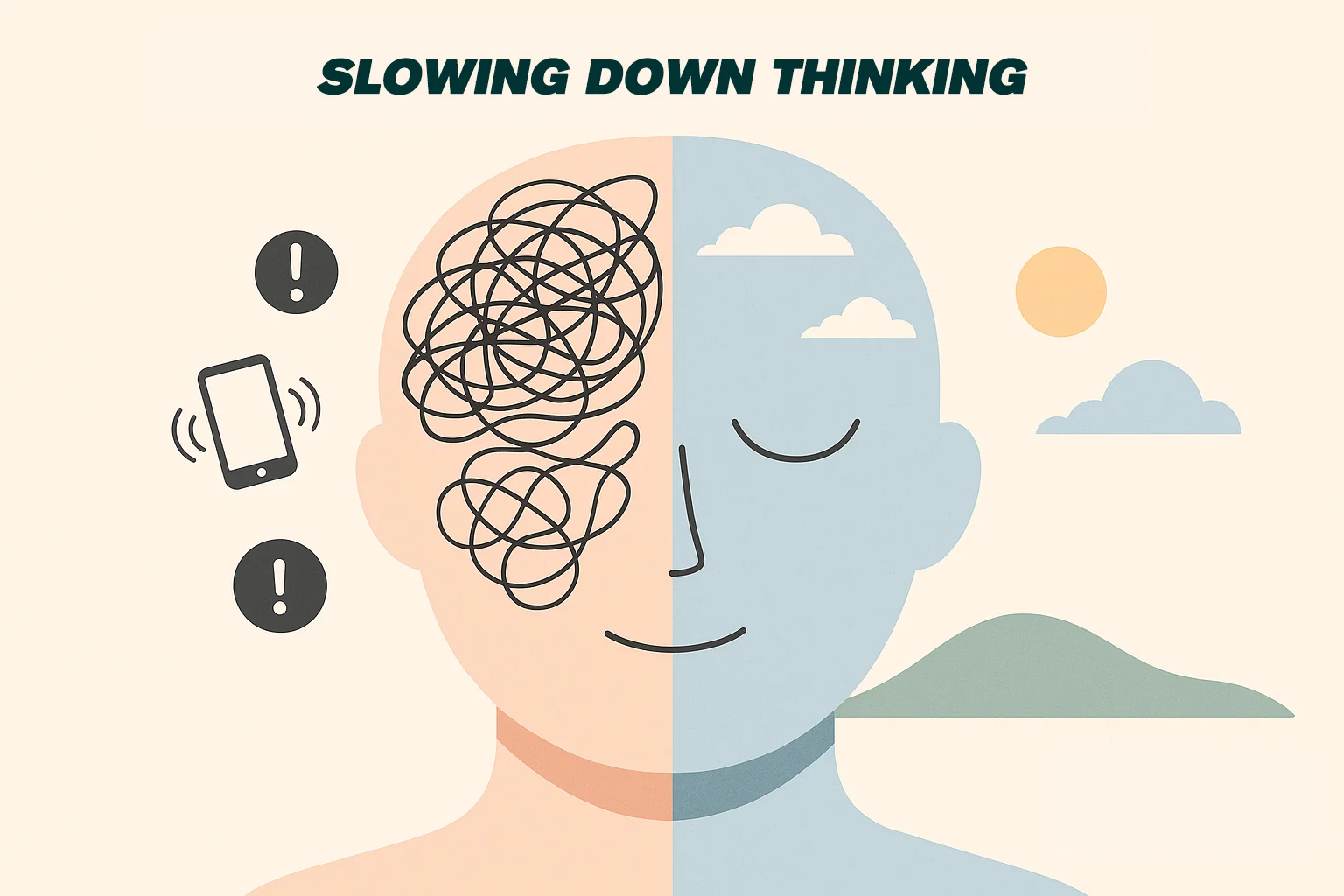
What is meant by slowing down thinking in psychology
Slowing down thinking refers to reducing rapid, automatic, and repetitive cognitive activity. From a psychological perspective, it involves easing cognitive overload and allowing thoughts to unfold at a sustainable pace. This state supports more effective information processing, mental organization, and internal coherence.
Why modern thinking often feels rushed and scattered
Contemporary environments encourage constant stimulation, multitasking, and rapid responsiveness. These conditions accelerate thought patterns and fragment attention. When the mind shifts continuously between stimuli, it becomes difficult to form clear and integrated mental representations, resulting in mental noise rather than clarity.
How fast thinking contributes to mental fatigue
Rapid thinking places sustained demands on working memory and attentional systems. When multiple thoughts compete simultaneously, cognitive efficiency decreases. Mental fatigue emerges not from depth of thought, but from insufficient time for processing and integration.
Why slowing down supports clearer attention
A slower thinking pace allows attentional resources to stabilize. Instead of frequent task-switching, the mind can remain engaged with a single focus. This sustained attention improves comprehension, awareness, and the ability to distinguish relevant information from background mental activity.
How thinking speed influences mental clarity
Mental clarity depends more on cognitive organization than speed. Slower thinking gives the brain time to structure information, recognize patterns, and establish meaningful connections. When thoughts are processed fully, the mind experiences greater order and ease.
The relationship between slower thinking and reduced overthinking
Overthinking is often driven by repetitive, unresolved thought loops. Slowing down introduces psychological space between thoughts, interrupting automatic repetition. This space allows reflective thinking without rumination, supporting mental calm.
How emotional states affect thinking pace
Emotional arousal naturally accelerates thought processes. When emotional intensity decreases, thinking slows without deliberate effort. Calmer emotional states support clearer evaluation, balanced interpretation, and reduced reactivity.
Why mental clarity improves when internal pressure decreases
Internal pressure narrows attention and promotes urgency-driven thinking. Reducing this pressure allows broader awareness and cognitive flexibility. Clarity tends to emerge as a byproduct of reduced mental demand rather than forced effort.
How slower thinking supports better decision-making
Slower cognitive states allow time to evaluate assumptions, weigh alternatives, and consider long-term outcomes. Decisions made under these conditions tend to feel more balanced, deliberate, and aligned.
Everyday experiences that naturally slow thinking
Quiet routines, focused reading, gentle physical movement, and intentional pauses naturally reduce cognitive speed. These experiences provide recovery time for the brain, restoring clarity without mental strain.
Why slowing down can initially feel uncomfortable
A mind habituated to constant stimulation may experience discomfort when cognitive activity slows. This response reflects adjustment rather than dysfunction. With time, the nervous system adapts to a quieter mental pace.
Can mental clarity be forced
Psychologically, mental clarity cannot be forced without increasing tension. Attempts to control or accelerate clarity often intensify mental noise. Allowing thoughts to slow creates conditions where clarity arises naturally.

How slower thinking supports long-term mental well-being
Consistently regulated thinking reduces cognitive strain and supports emotional balance. Over time, this pattern contributes to psychological resilience, improved focus, and sustained inner calm.
Why peace and clarity are closely connected
Peaceful mental states reduce internal conflict and unnecessary cognitive effort. When the mind is not rushing or resisting itself, clarity becomes more accessible. Peace and clarity function as mutually reinforcing psychological states.

Leave a Comment