
What is fast and slow thinking in psychology?
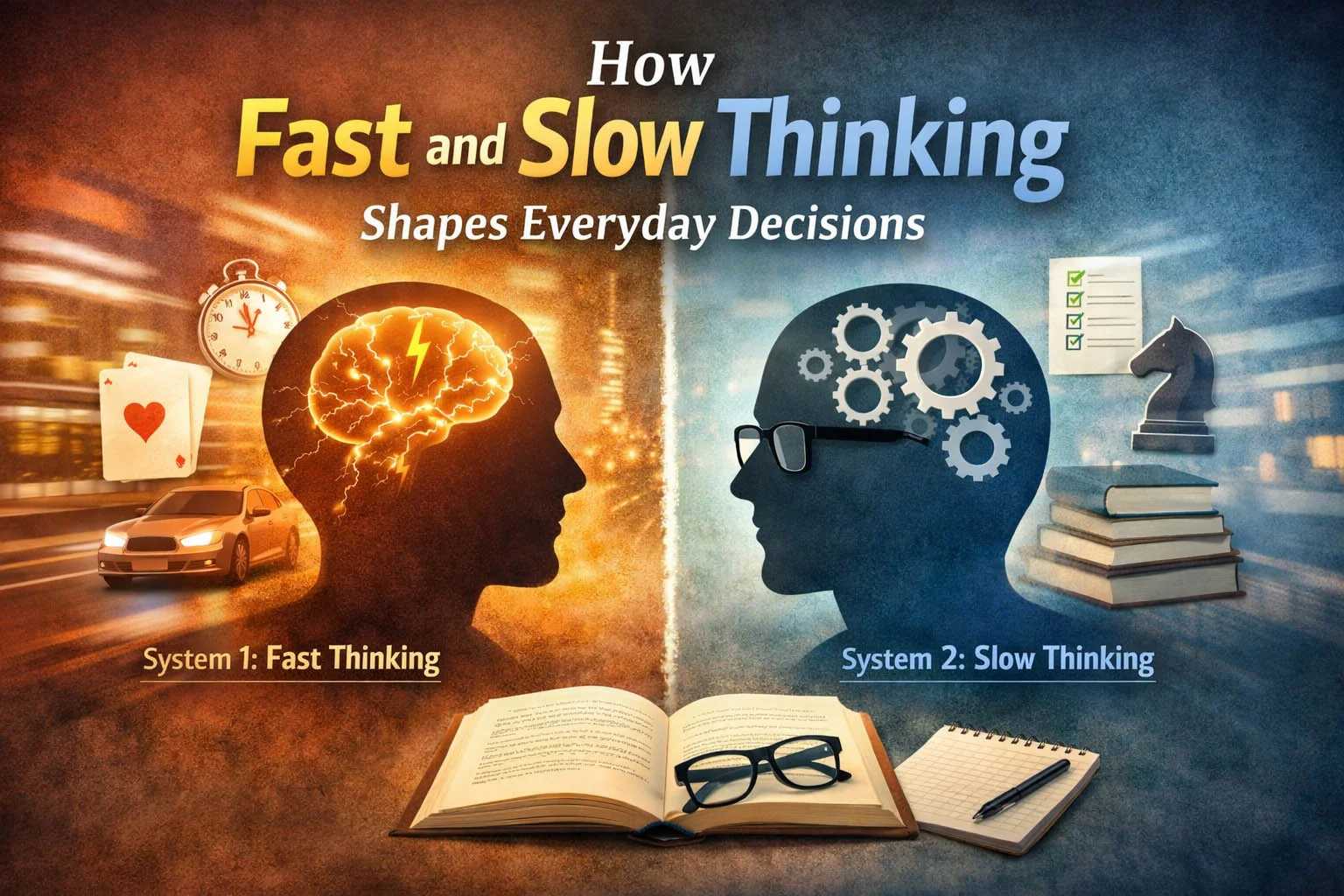
Fast and slow thinking refers to a dual-process theory of cognition introduced by Daniel Kahneman. This framework explains how human thinking operates through two distinct systems.
System 1 (fast thinking) is automatic, intuitive, and rapid. It operates with little effort and is responsible for immediate judgments, pattern recognition, and emotional responses.
System 2 (slow thinking) is deliberate, analytical, and effortful. It is activated when deeper reasoning, complex problem-solving, or conscious evaluation is required.
This distinction forms the foundation of modern cognitive psychology, helping explain why humans often rely on intuition even in situations that demand logic.
Why does the brain rely on two different thinking systems?
The human brain is designed for efficiency. Constantly engaging in deep, analytical thinking would consume excessive cognitive energy. As a result, fast thinking acts as a mental shortcut system, allowing quick responses to everyday situations.
From an evolutionary perspective, rapid decision-making increased survival chances. Immediate reactions to threats or opportunities were more valuable than prolonged analysis.
Slow thinking, however, plays a crucial role in situations that require accuracy over speed. It enables reflection, planning, and critical evaluation. The interaction between these systems ensures both efficiency and adaptability in human cognition.
How does fast thinking influence everyday decisions?
Fast thinking dominates most daily decisions. It relies heavily on heuristics—mental shortcuts that simplify complex information.
While efficient, this system is also prone to cognitive biases such as:
- Availability bias
- Anchoring effect
- Confirmation bias
These biases can lead to systematic errors in judgment. For example, quick assumptions about people, impulsive purchases, or snap decisions in uncertain situations often originate from System 1 processing.
Because fast thinking operates automatically, individuals are often unaware of its influence on behavior.
What are the limitations of slow thinking?
Although slow thinking is more accurate, it is not always practical. It requires significant mental effort and is limited by cognitive capacity.
Some key limitations include:
- Mental fatigue during prolonged analysis
- Reduced efficiency in time-sensitive situations
- Tendency to avoid effortful thinking altogether
This often leads individuals to default back to fast thinking, even when careful reasoning would be more beneficial.
How do fast and slow thinking interact in real-life situations?
Rather than functioning independently, both systems continuously interact. Fast thinking generates initial impressions, while slow thinking may monitor or override those impressions when necessary.
For instance:
- First impressions are formed quickly (System 1)
- Logical evaluation of those impressions occurs later (System 2)
However, System 2 does not always intervene. In many cases, intuitive judgments remain unchallenged, leading to biased or incomplete decisions.
How can individuals improve decision-making using both systems?
Improving decision-making involves recognizing when to rely on each system and creating conditions that support balanced thinking.
Key strategies include:
Slowing down critical decisions
Important choices benefit from deliberate analysis rather than immediate reactions.
Questioning intuitive judgments
Actively challenging first impressions can reduce cognitive bias.
Reducing cognitive overload
Simplifying environments and limiting distractions helps preserve mental energy for deeper thinking.
Using structured thinking tools
External aids such as journals, planners, or decision frameworks can support System 2 engagement by organizing thoughts and reducing mental strain.
What role do external tools play in supporting better thinking?
Cognitive processes are influenced not only by internal mechanisms but also by environmental supports. External tools can enhance decision quality by reducing reliance on automatic thinking.
For example:
- Writing down decisions encourages reflective processing
- Structured planners help break complex problems into manageable steps
- Timers and focus tools reduce distractions, allowing sustained attention
A deeper exploration of these concepts is presented in
👉 Thinking, Fast and Slow
https://amzn.to/3O7Iko9
This work provides extensive insight into how cognitive biases operate and how individuals can become more aware of their thinking patterns.
Why is understanding fast and slow thinking important in modern life?
Modern environments are filled with information overload, constant distractions, and rapid decision demands. These conditions amplify reliance on fast thinking, increasing the likelihood of cognitive errors.
Understanding the balance between intuitive and analytical thinking allows individuals to:
- Make more informed decisions
- Reduce bias in judgment
- Improve problem-solving accuracy
- Enhance self-awareness in behavior
In professional, academic, and personal contexts, this awareness becomes a critical cognitive advantage.
How can this concept be applied in everyday behavior?
Applying dual-process theory in daily life involves small but consistent behavioral adjustments.
Examples include:
- Pausing before making important decisions
- Reflecting on reasoning rather than outcomes alone
- Creating structured environments that minimize impulsive reactions
- Developing habits that encourage thoughtful evaluation
Over time, these practices strengthen the ability to engage slow thinking when necessary, leading to more balanced and effective decision-making.


Leave a Comment