
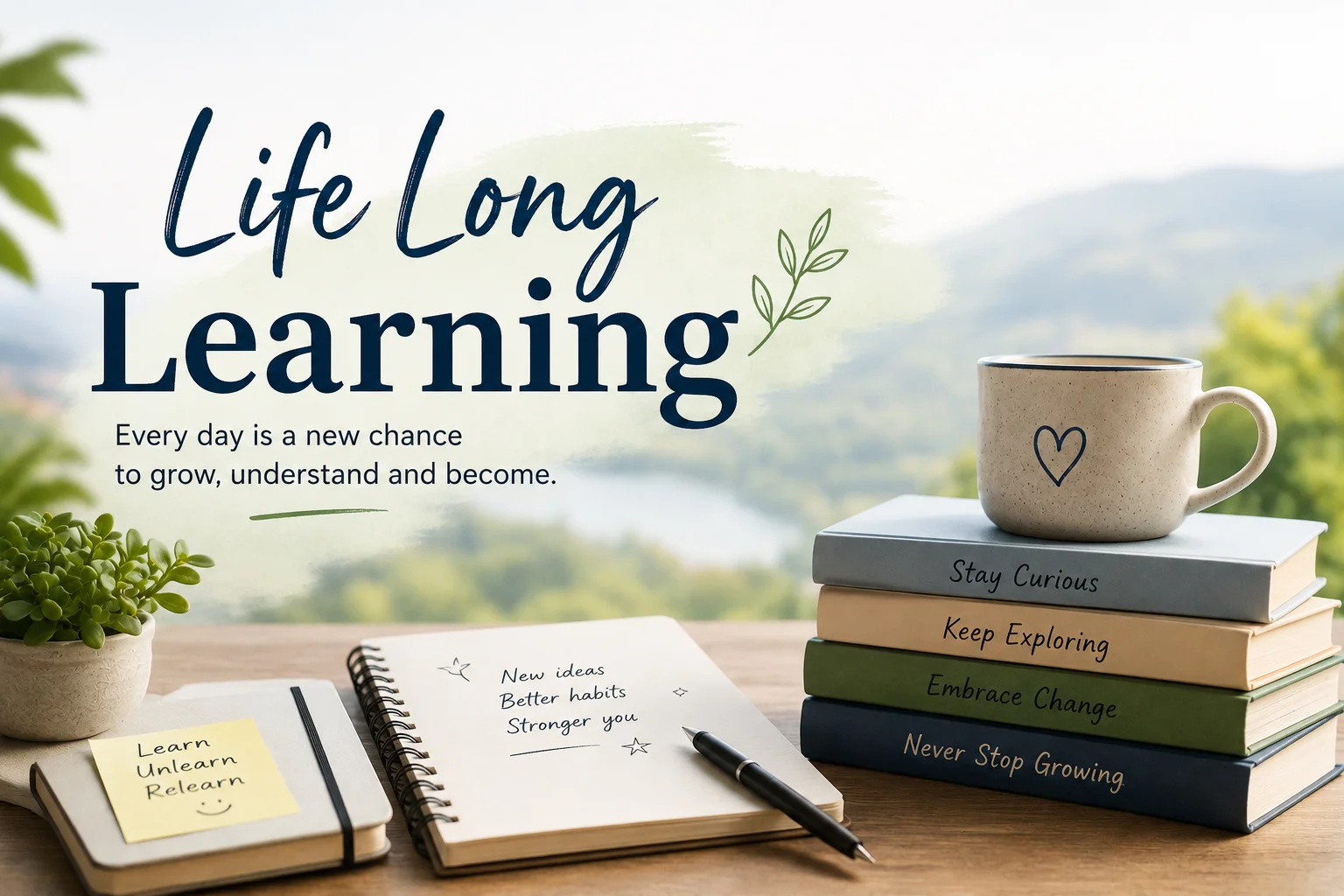
Learning is often associated with classrooms, textbooks, exams, and formal education. But psychology tells us that learning is much bigger than education. It is a continuous part of being human.
People learn from conversations, mistakes, observation, relationships, work, changing environments, and everyday experiences. Even when formal education ends, the brain continues to adapt to new information and experiences.
The interesting question is not whether people continue learning, but why learning continues throughout life.
What does lifelong learning mean?
Lifelong learning means continuing to gain knowledge, skills, understanding, and new perspectives throughout life.
It does not necessarily mean taking courses or earning qualifications. Learning can be as simple as discovering a better way to solve a problem, understanding another person’s point of view, learning a new skill, or changing an old assumption after encountering new evidence.
People also learn by watching others. The psychology of this process is explored in Social Learning Theory and How We Learn by Watching Others.
A person may learn deliberately by reading a book or practicing a skill. Learning can also happen naturally through everyday experiences.
This makes learning less like a stage of life and more like a continuous process.
Why does the brain keep learning?
The brain is designed to respond to experience.
When people encounter something new, the brain processes the information, compares it with what is already known, and adjusts its understanding when necessary. Repeated experiences can strengthen certain patterns of thinking and behavior.
This ability is closely related to neuroplasticity, the brain’s capacity to change and adapt in response to experience.
Neuroplasticity does not mean that the brain can change without limits. Instead, it means that the brain remains capable of adapting throughout life.
This is one reason learning does not have a simple expiration date.
Does learning stop after school?
No.
Formal education may eventually end, but learning continues in different forms.
A person might learn how to communicate more effectively after entering the workplace. Someone may discover new approaches to managing time after becoming responsible for several tasks. Another person may change their understanding of relationships after gaining more life experience.
These experiences may not come with certificates, but they can still produce meaningful learning.
School provides structured opportunities to learn. Life provides countless unstructured ones.
How does experience become learning?
Experience alone does not automatically guarantee learning.
Two people can experience the same event and come away with completely different lessons.
Learning often becomes stronger when people pay attention to what happened, think about why it happened, and consider what could be done differently next time.
This process is sometimes described as reflective learning.
For example, making a mistake can simply remain an unpleasant memory. But if someone examines the mistake and identifies what caused it, the experience can become useful information for future decisions.
In this way, reflection can turn experience into knowledge.
Why do mistakes sometimes teach more than success?
Success can show that something worked.
Failure can reveal why something did not work.
When an expected result does not happen, people have an opportunity to examine their assumptions, strategies, and decisions. This can create a strong reason to search for new information or try a different approach.
However, mistakes do not automatically produce learning. A person can repeat the same mistake many times without understanding what needs to change.
The useful part is not failure itself. It is the learning process that can follow it.
Why does curiosity keep learning alive?
Curiosity creates a desire to understand.
When people encounter something unfamiliar, they may naturally ask questions such as:
Why does this happen?
How does this work?
What would happen if something changed?
Questions encourage exploration, and exploration creates opportunities for learning.
Curiosity also helps prevent knowledge from becoming fixed. Instead of assuming that everything is already understood, curious people remain open to discovering something new.
This is one reason curiosity can be valuable throughout life.
Can adults learn as effectively as younger people?
Adults and younger people may learn differently, but adulthood does not mean that learning ability disappears.
Adults bring previous knowledge and experience to new information. This can sometimes make learning easier because new ideas can be connected to things already understood.
At the same time, established habits and assumptions can sometimes make it harder to accept information that conflicts with existing beliefs.
The important point is that learning ability does not simply switch off with age.
People continue developing knowledge and skills throughout adulthood.
For a deeper look at how learning develops during childhood, see Piaget’s Cognitive Development and How Children Learn to Think.
Why does learning sometimes become harder?
Learning can become more difficult when people become overly comfortable with what they already know.
Familiarity can create a feeling of certainty. Once an idea becomes deeply established, information that challenges it may be dismissed rather than explored.
Another barrier is the fear of being wrong.
If being wrong is viewed as something embarrassing, people may avoid asking questions or trying unfamiliar things. When mistakes are treated as information rather than personal failure, experimentation becomes easier.
Learning requires some degree of openness.
How do habits influence learning?
Much of everyday behavior becomes habitual.
Habits allow people to perform familiar actions without constantly thinking through every step. This is useful because it reduces the mental effort required for routine activities.
However, habits can also make people less likely to explore alternatives.
Learning often requires noticing when an old approach is no longer effective and becoming willing to experiment with a new one.
Sometimes the most important learning happens when a familiar routine is interrupted.
Why is unlearning also important?
Learning is not only about adding information.
Sometimes people need to unlearn outdated assumptions, ineffective habits, or inaccurate beliefs.
For example, someone may discover that a strategy that worked several years ago is no longer effective in a different environment.
Unlearning does not mean forgetting everything.
It means recognizing that previous knowledge may need to be updated.
This is an important part of psychological flexibility because the world changes, circumstances change, and people change.
Does learning change the way people see themselves?
Yes.
Learning can influence identity.
A person who learns a new skill may begin to see themselves as capable of doing something they previously considered impossible. Someone who develops a deeper understanding of another culture or perspective may reconsider assumptions they once held.
Knowledge can therefore influence not only what people know, but also how they understand themselves and the world around them.
Learning can expand the boundaries of what a person believes they are capable of doing.
Why does learning continue even when people are not trying?
People constantly receive information from their surroundings.
Conversations, social interactions, observation, routines, media, work, and unexpected experiences can all provide information.
The brain continuously processes these experiences and builds associations between them.
Not all of this becomes useful or accurate knowledge. People can also learn habits, assumptions, and incorrect beliefs.
This is why what people repeatedly experience and pay attention to matters.
Learning is continuous, but the quality of learning can vary.
Can technology change lifelong learning?
Technology has made access to information easier than ever.
People can learn through online courses, videos, digital books, podcasts, educational platforms, and interactive tools without being physically present in a classroom.
However, having access to information is not the same as learning.
Learning still requires attention, understanding, evaluation, and application.
In a world where information is abundant, the ability to identify reliable information and think critically about it becomes increasingly important.
Why is learning connected to adaptability?
The environment around people rarely stays exactly the same.
Technology changes. Work changes. Social expectations change. New information becomes available. Personal responsibilities change.
Adaptability allows people to respond to these changes rather than relying entirely on old patterns.
Learning supports adaptability because it gives people new information and strategies for dealing with unfamiliar situations.
In this sense, learning is not simply about becoming more knowledgeable. It is also about becoming better prepared for change.
What happens when people stop being curious?
A lack of curiosity can narrow exploration.
When people assume that they already know enough, they may stop asking questions, exploring alternatives, or reconsidering their assumptions.
This does not mean that every belief needs to be questioned constantly. Stability and confidence are also useful.
The goal is balance.
Healthy learning involves knowing what is understood while remaining open to the possibility that something new may be discovered.
How can everyday life become a learning environment?
Almost any ordinary experience can become an opportunity to learn.
A conversation can teach something about communication.
A mistake can reveal a weak strategy.
A new responsibility can develop a skill.
A disagreement can expose a different perspective.
A new environment can challenge assumptions.
The key difference is attention.
When people consciously notice what an experience is teaching them, everyday events can become valuable sources of knowledge.
Why learning never really stops
Learning continues because humans live in changing environments and interact with constantly changing information.
The brain adapts to experience. Curiosity encourages exploration. Reflection helps people extract lessons from experience. New challenges create opportunities to develop different skills.
Formal education may have an ending point, but learning itself does not.
There is always something that can be understood more deeply, a skill that can be improved, an assumption that can be reconsidered, or a perspective that can be explored.
Perhaps that is one of the most interesting facts about human behavior.
We may finish school, but we never really finish learning.
Frequently Asked Questions
Is lifelong learning only about education?
No. Lifelong learning includes formal education, but it also includes skills, experiences, observations, conversations, problem-solving, and changes in perspective.
Can learning happen without conscious effort?
Yes. People can learn patterns, habits, associations, and information through repeated experiences and observation without deliberately studying them.
Why is curiosity important for learning?
Curiosity encourages people to ask questions and explore unfamiliar information. It creates a natural motivation to understand something more deeply.
Can people learn new things at any age?
Yes. People can continue developing knowledge and skills throughout life. Learning may change with age and experience, but it does not simply stop.
What is the difference between learning and memorizing?
Memorizing involves retaining information. Learning generally involves understanding, connecting, applying, or changing behavior based on information and experience.
Why is unlearning important?
Some knowledge, assumptions, or habits may become outdated. Unlearning allows people to reconsider old patterns and make room for more useful information.
What is the simplest way to keep learning?
Stay curious, ask questions, pay attention to experience, seek reliable information, and remain willing to reconsider what is already believed to be true.

Leave a Comment