
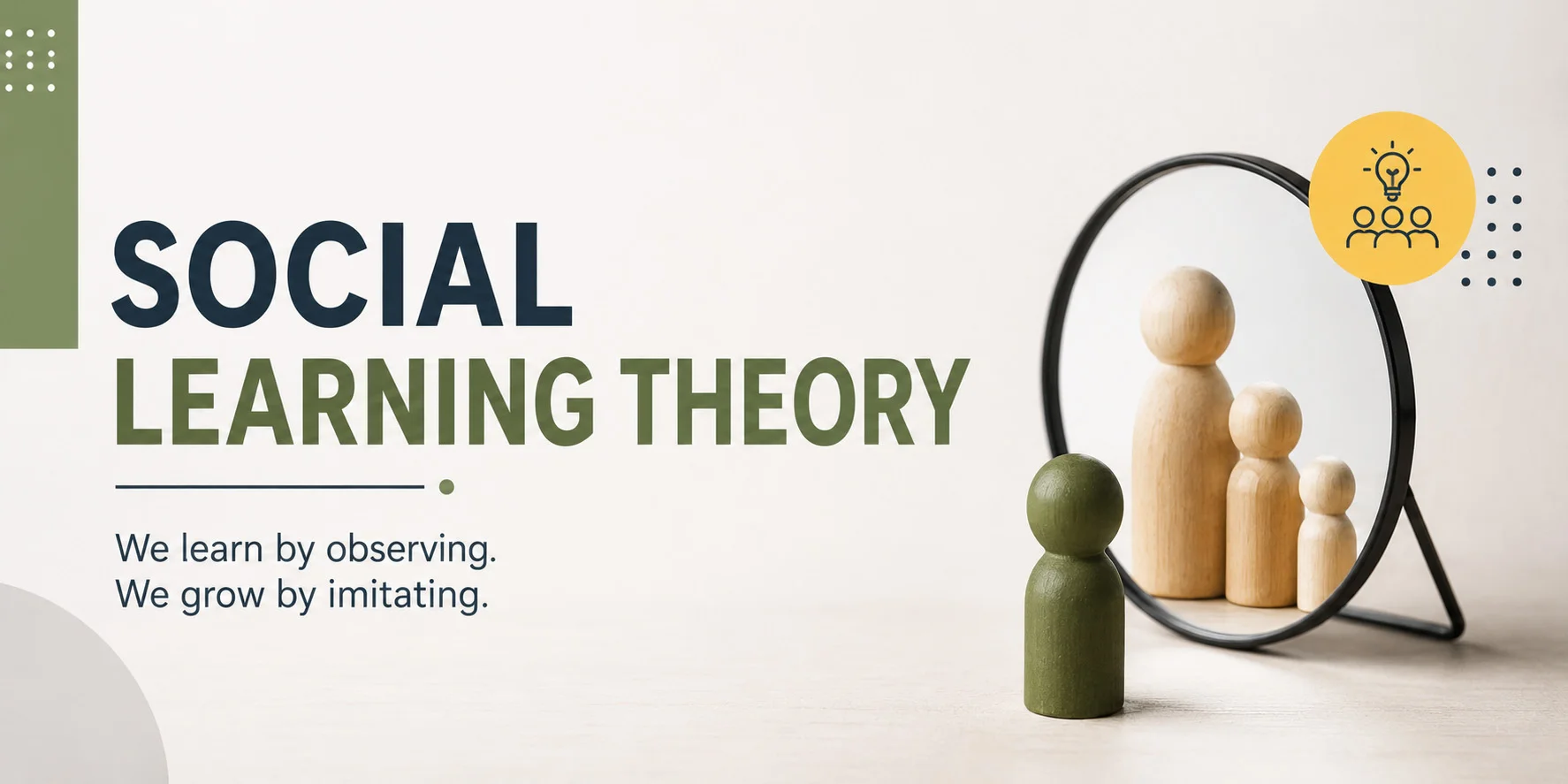
Have you ever noticed a child copying a parent’s behavior or a friend picking up a new habit after spending time with someone? We often learn without being directly taught. Simply watching other people can change the way we think, feel, and behave.
This idea is explained by Social Learning Theory, one of the most influential theories in psychology. It shows that learning is not only based on rewards and punishments. We also learn by observing the people around us.
What Is Social Learning Theory?
Social Learning Theory explains that people learn new behaviors by watching others and copying what they see. Instead of learning only through personal experience, we can learn from the experiences of family members, friends, teachers, coworkers, celebrities, and even fictional characters.
The theory was developed by psychologist Albert Bandura during the 1960s. His research changed the way psychologists understood learning and human behavior.
How Does Social Learning Theory Work?
According to the theory, learning happens through four main steps.
Attention
First, we must notice the behavior. We pay more attention to people we admire, trust, or see as successful.
For example, a child carefully watches how a parent speaks to others.
Retention
Next, we remember what we observed. If the behavior is memorable or repeated often, it is easier to recall later.
For example, a student remembers how a teacher solved a difficult math problem.
Reproduction
After remembering the behavior, we try to perform it ourselves. Practice helps improve the skill over time.
For example, someone learns to play a musical instrument after watching online tutorials.
Motivation
Finally, we decide whether it is worth repeating the behavior. If we see positive results or rewards, we are more likely to continue doing it.
For example, if a child is praised for sharing toys, they may continue sharing in the future.
The Famous Bobo Doll Experiment
One of the best-known psychology experiments supporting Social Learning Theory is the Bobo doll experiment.
In this study, children watched adults interact with a large inflatable doll.
Some adults behaved aggressively toward the doll, while others acted calmly.
When the children were later given the same doll, many who had watched aggressive behavior copied those actions. This showed that people can learn behaviors simply by observing others, even without receiving direct rewards or punishments.
The experiment highlighted how powerful observation can be in shaping behavior.
Why Is Social Learning Theory Important?
Social Learning Theory helps explain many everyday behaviors.
It shows why children often copy their parents, why people follow trends on social media, and why role models have such a strong influence.
The theory reminds us that our environment plays a major role in the habits we develop.
Real Life Examples
Parenting
Children often imitate how parents handle stress, solve problems, and communicate with others.
School
Students learn by observing teachers and classmates, not just through textbooks.
Workplace
New employees often understand company culture by watching experienced coworkers.
Sports
Athletes improve by observing skilled players and practicing similar techniques.
Social Media
Many people adopt fashion styles, fitness routines, and even opinions after watching influencers online.
Strengths of Social Learning Theory
- Explains how people learn naturally in everyday life.
- Shows the importance of role models.
- Helps improve education and training.
- Supports positive behavior through good examples.
- Applies to children and adults alike.
Limitations of Social Learning Theory
While the theory is powerful, it does not explain every behavior.
People also make decisions based on personality, emotions, biology, and personal experiences. Two people may watch the same behavior but react differently because of their unique backgrounds.
How Can You Use Social Learning Theory?
You can apply this theory in your daily life by choosing positive influences.
- Spend time with people who encourage healthy habits.
- Follow role models who inspire personal growth.
- Be aware that others may copy your actions.
- Teach through example rather than words alone.
- Limit exposure to negative behaviors that you do not want to imitate.
Key Takeaways
Social Learning Theory teaches us that learning happens everywhere, not just in classrooms.
Every conversation, workplace, family gathering, and online interaction gives us opportunities to observe and learn. Our actions also influence others, often without us realizing it.
By surrounding ourselves with positive role models and becoming good examples ourselves, we can create healthier habits and stronger communities.
Frequently Asked Questions
Who created Social Learning Theory?
Social Learning Theory was developed by psychologist Albert Bandura.
What is the main idea of Social Learning Theory?
The theory explains that people learn by observing others, remembering what they see, and repeating those behaviors when they are motivated to do so.
Is Social Learning Theory only for children?
No. Adults also learn by watching coworkers, friends, leaders, and people they admire.
Why is Social Learning Theory important in education?
Teachers serve as role models. Students often learn attitudes, behaviors, and social skills by observing their teachers and classmates.
Can social media influence learning?
Yes. Social media exposes people to countless behaviors, opinions, and habits that can be copied, both positive and negative.
Final Thoughts
Social Learning Theory reminds us that learning happens every day through observation. Whether we realize it or not, we are constantly influenced by the people around us, and our own actions influence others in return.
Choosing positive role models and setting a good example can have lasting effects on both personal growth and the people in our lives.

Leave a Comment