
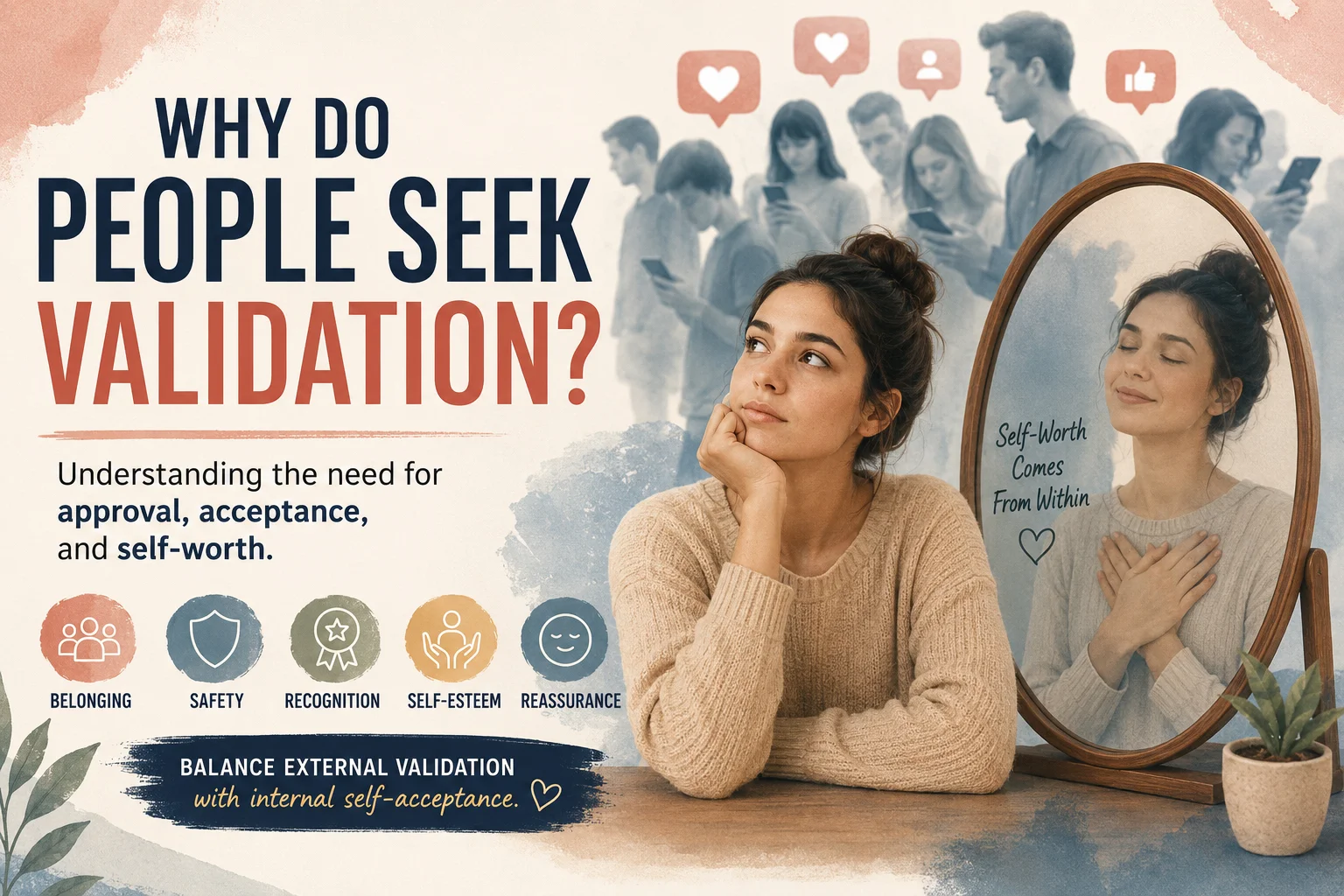
Validation is a fundamental part of human social life. People often look for approval, recognition, acceptance, and reassurance from others. While seeking validation is a normal psychological behavior, excessive dependence on external approval can affect confidence, decision-making, and emotional well-being.
Understanding why people seek validation helps explain many everyday behaviors, from social media engagement to workplace performance and personal relationships.
What Does Validation Mean in Psychology?
Validation refers to the acknowledgment, acceptance, or confirmation of a person’s thoughts, feelings, behaviors, or experiences.
Psychologically, validation can come from two sources:
- External validation: Approval or recognition from other people.
- Internal validation: Acceptance and acknowledgment of oneself without needing outside approval.
Both forms play important roles, but problems often arise when external validation becomes the primary source of self-worth.
Why Do People Seek Validation?
People seek validation because humans are inherently social beings. Throughout human history, belonging to a group increased survival chances. As a result, the brain developed mechanisms that reward social acceptance and discourage rejection.
Seeking validation can satisfy several psychological needs:
- Belonging
- Safety
- Social acceptance
- Recognition
- Self-esteem
- Emotional reassurance
Validation helps people feel valued and connected to others.
How Does Childhood Influence Validation-Seeking Behavior?
Early life experiences often shape how much validation a person seeks later in life.
Children who receive consistent emotional support typically develop a stable sense of self-worth. They learn that their value does not depend entirely on other people’s opinions.
However, some childhood experiences may increase the need for validation:
- Excessive criticism
- Conditional love and approval
- Emotional neglect
- Unpredictable parenting
- Constant comparison with siblings or peers
When approval becomes linked to performance or behavior, individuals may grow up believing that their worth depends on meeting external expectations.
Is Validation Seeking Connected to Self-Esteem?
Yes. Self-esteem and validation-seeking are closely related.
People with healthy self-esteem tend to value feedback without becoming dependent on it. They can maintain confidence even when others disagree with them.
Individuals with lower self-esteem may rely heavily on praise and reassurance because external approval temporarily boosts their sense of worth.
Research suggests that stable self-esteem is associated with greater emotional resilience and reduced dependence on social approval.
Why Does Social Media Increase the Need for Validation?
Social media platforms provide immediate opportunities for external validation through:
- Likes
- Comments
- Shares
- Followers
- Reactions
These forms of feedback can activate reward-related brain systems, creating a cycle where individuals repeatedly seek approval.
People may begin to associate social engagement metrics with personal value, even though these metrics often reflect algorithms, timing, and audience behavior rather than true self-worth.
This does not mean social media is harmful by itself. However, excessive focus on online approval can increase anxiety, comparison, and self-doubt.
Why Do Some People Need Constant Reassurance?
Constant reassurance often serves as a way to reduce uncertainty and emotional discomfort.
Individuals may repeatedly seek confirmation about:
- Their appearance
- Relationships
- Decisions
- Performance
- Social standing
Although reassurance can provide temporary relief, it may not address underlying insecurities. As a result, the need for reassurance often returns, creating a repetitive cycle.
Developing confidence and self-trust can help reduce excessive reassurance-seeking behaviors.
Is Seeking Validation Always Unhealthy?
No. Seeking validation is not inherently negative.
Healthy validation can:
- Strengthen relationships
- Improve communication
- Support emotional well-being
- Encourage personal growth
- Reinforce positive behaviors
For example, receiving recognition for hard work or emotional support during difficult times can be beneficial.
The concern arises when self-worth becomes entirely dependent on external approval.
What Are the Signs of Excessive Validation Seeking?
Some common signs include:
- Fear of disappointing others
- Difficulty making independent decisions
- Constant need for praise
- Excessive people-pleasing
- Sensitivity to criticism
- Anxiety about social rejection
- Frequent comparison with others
These behaviors may indicate that external approval has become a primary source of confidence.
Why Does Rejection Feel So Painful?
Humans are biologically wired to value social connection.
Studies suggest that social rejection activates brain regions associated with emotional distress. From an evolutionary perspective, exclusion from a group could threaten survival, making sensitivity to rejection an adaptive trait.
Although modern society is different from ancestral environments, the emotional impact of rejection remains powerful.
This is one reason why criticism, exclusion, or disapproval can feel intensely personal.
How Can People Build Internal Validation?
Internal validation involves recognizing personal worth without relying entirely on others.
Several strategies can help:
Practice Self-Awareness
Understanding personal values, strengths, and goals reduces dependence on external opinions.
Develop Self-Compassion
Treating oneself with kindness during setbacks promotes emotional resilience.
Focus on Personal Standards
Evaluating success according to meaningful personal goals rather than social comparisons can strengthen confidence.
Accept Imperfection
Recognizing that mistakes are a normal part of growth reduces the need for constant approval.
Limit Comparison Habits
Reducing unnecessary comparison can help shift attention toward personal development rather than external judgment.
What Is the Difference Between Validation and Approval?
Although often used interchangeably, they are not identical.
Validation means acknowledging or understanding someone’s experience.
Approval means agreeing with or endorsing someone’s behavior or choices.
A person can feel validated even when others disagree with them. Understanding this distinction can improve relationships and emotional well-being.
Can People Stop Seeking Validation Completely?
Probably not, and that is not necessarily the goal.
Humans naturally care about social feedback. The healthier objective is balance.
People can benefit from appreciation, recognition, and encouragement while maintaining a stable sense of self-worth that does not depend entirely on external opinions.
When internal validation becomes stronger, external feedback becomes informative rather than defining.
Conclusion
People seek validation because it fulfills important psychological needs related to belonging, acceptance, recognition, and self-esteem. While seeking approval from others is a normal part of human behavior, excessive dependence on external validation can undermine confidence and emotional well-being.
Building internal validation through self-awareness, self-compassion, and personal growth allows individuals to appreciate feedback without becoming controlled by it. The healthiest approach is not eliminating the need for validation but creating a balanced relationship between external recognition and internal self-worth.


Leave a Comment