
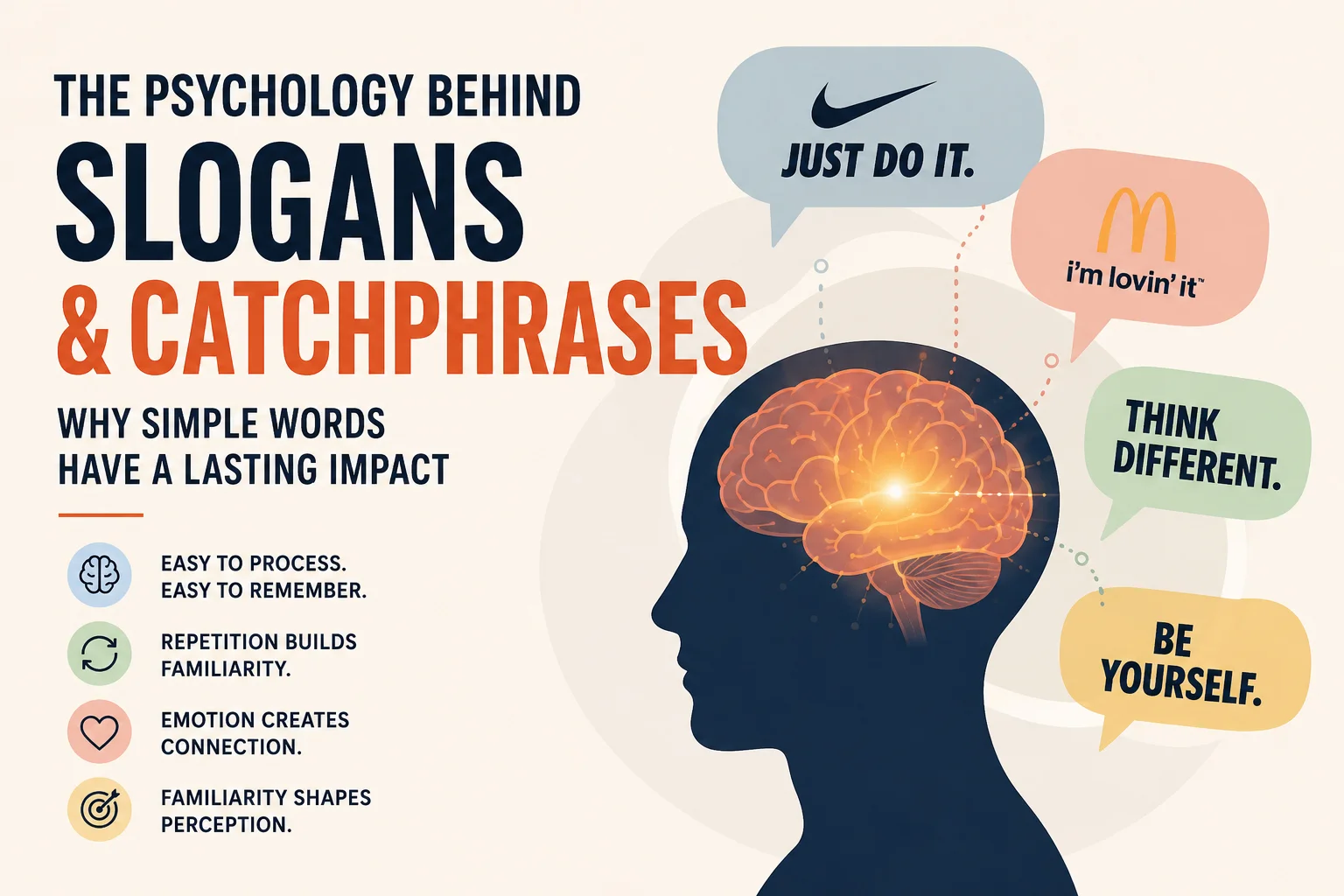
What makes certain phrases unforgettable?
Some phrases remain memorable long after they are heard. Short expressions, slogans, and catchphrases often become easy to recall because they are simple, repetitive, and easy for the brain to process.
The mind naturally favors information that requires less cognitive effort. When words are concise and familiar, they become easier to recognize, repeat, and remember.
This is why certain phrases continue to appear in memory even after brief exposure.
What philosophical idea relates to catchphrases?
This topic connects to a philosophical question about language and perception:
Do words merely describe reality, or can repeated words shape how reality is perceived?
Throughout history, philosophers have explored how language influences thought. Repeated phrases can gradually influence interpretation, not necessarily because they are deeply analyzed, but because familiarity creates a sense of certainty.
This reveals an important principle:
What is repeated often begins to feel important.
Is there a simple illustration of this idea?
A traveler once entered a busy marketplace where the same phrase appeared everywhere, painted on signs, repeated in conversations, and spoken by merchants.
At first, the phrase seemed ordinary. But after hearing it repeatedly throughout the day, the traveler noticed something unusual: the words began to feel meaningful and persuasive, even without careful reflection.
The phrase had not changed.
What changed was familiarity.
This illustrates how repeated exposure can increase the psychological impact of simple language.
How does psychology explain why catchphrases stay in memory?
Psychology explains this through several cognitive mechanisms related to attention, memory, and familiarity.
One important concept is the Illusory Truth Effect, where repeated information feels more believable simply because it becomes familiar.
Several psychological factors strengthen the effect of catchphrases.
Cognitive fluency
Simple phrases are easier to process. Information that feels easy to understand is often perceived as more trustworthy and memorable.
Repetition
Repeated exposure strengthens recognition and memory retrieval.
Pattern recognition
The brain naturally remembers rhythmic, symmetrical, or predictable structures more easily than complex wording.
Familiarity bias
Frequently encountered phrases create a sense of comfort and recognition.
Why are short phrases easier to remember?
Short phrases reduce cognitive load. The brain can process and store them quickly without requiring extensive mental effort.
This efficiency improves:
- recall speed
- recognition
- repetition accuracy
Because of this, concise wording often has greater psychological impact than lengthy explanations.
Why does repetition increase the power of words?
Repetition strengthens neural associations connected to language.
Each repeated exposure increases familiarity, making phrases easier to retrieve from memory. Over time, this familiarity creates a sense of importance or credibility.
This process explains why repeated slogans often feel influential even when they contain very simple ideas.
How do rhythm and structure affect memory?
The brain responds strongly to predictable patterns.
Phrases that contain:
- rhythm
- symmetry
- repetition
- balanced wording
are easier to encode and recall.
This is why many memorable catchphrases use short, structured wording that flows naturally when spoken.
How do catchphrases influence perception?
Catchphrases simplify complex ideas into memorable language.
Instead of analyzing detailed information, the brain may rely on familiar phrases as mental shortcuts. Repeated wording can therefore shape perception by influencing which ideas remain easily accessible in memory.
This demonstrates how familiarity affects interpretation.
What does this reveal about human thinking?
The psychology behind catchphrases shows that human thinking is influenced not only by information itself, but by how information is presented.
The brain prioritizes:
- simplicity
- familiarity
- repetition
- ease of processing
As a result, repeated phrases often gain psychological influence through exposure alone.
Why is understanding this concept important?
Understanding how slogans and catchphrases work reveals how language interacts with attention and memory.
Psychology shows that:
- repeated phrases become easier to remember
- familiarity increases perceived credibility
- simple wording improves recall and recognition
Recognizing these patterns helps explain why certain phrases remain influential over time.

Leave a Comment