
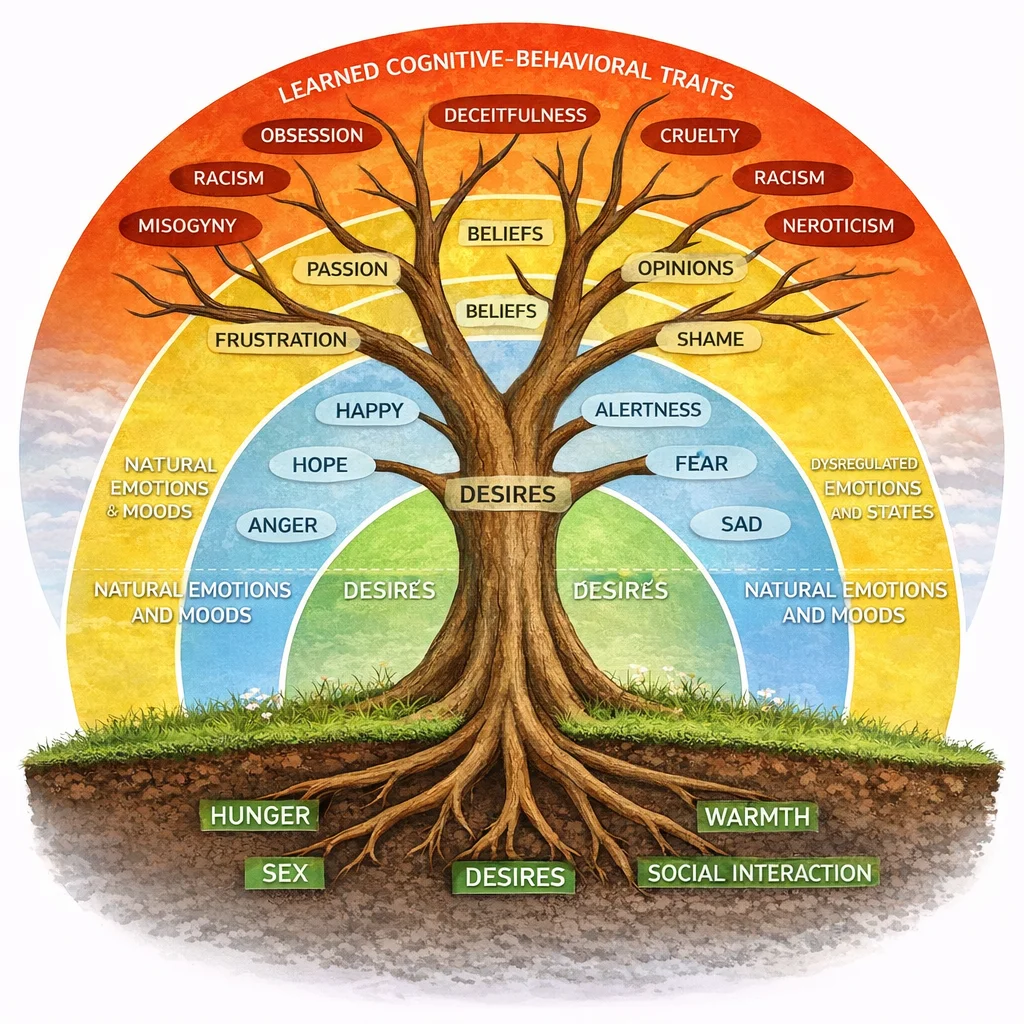
What is meant by the “tree of emotions, thoughts, and behaviors”?
The tree of emotions, thoughts, and behaviors is a conceptual psychological model that explains how human behavior develops in layered stages. It illustrates how basic needs generate emotions, emotions interact with thoughts, and repeated thinking patterns gradually shape behavior and personality traits.
Rather than viewing behavior as spontaneous or purely emotional, the model emphasizes a developmental process, where observable actions are the final outcome of deeper psychological layers.
Why is behavior placed at the top of the tree?
Behavior appears at the top of the tree because it is not the starting point, but the end result of multiple internal processes. Psychological research consistently shows that behavior is influenced by:
- Motivational states
- Emotional responses
- Cognitive interpretations
- Learned belief systems
The tree structure visually reinforces that changing behavior without addressing underlying layers often leads to temporary or unstable outcomes.
What role do basic needs play in shaping behavior?
Basic needs such as hunger, warmth, safety, sexual expression, and social connection form the root system of the tree. These needs generate motivational energy that drives emotional responses.
However, unmet needs do not directly cause maladaptive behavior. Instead, the way unmet needs are interpreted and regulated cognitively determines whether behavior becomes adaptive or harmful.
How do desires influence emotional reactions?
Desires act as the psychological trunk, connecting basic needs to emotional experience. When desires are blocked, delayed, or threatened, emotions naturally arise.
For example:
- Blocked social desire may produce sadness or frustration
- Threatened safety desire may produce fear or alertness
Desires themselves are value-neutral; they become psychologically significant only through emotional and cognitive processing.
Are emotions responsible for harmful behavior?
No. Emotions are biologically adaptive signals, not behavioral instructions. Emotions such as anger, fear, or sadness evolved to support survival and decision-making.
The tree model deliberately separates natural emotions from harmful behaviors to demonstrate that emotions do not inherently produce cruelty, prejudice, or aggression. Such outcomes emerge when emotions are persistently filtered through distorted or rigid thinking patterns.
What are primary and secondary emotional states?
Primary emotions are immediate, natural reactions to internal or external events. These include happiness, fear, sadness, anger, hope, and love.
Secondary emotional states develop when primary emotions are:
- Suppressed
- Repeatedly reinterpreted negatively
- Poorly regulated over time
Examples include chronic shame, prolonged frustration, dread, or emotional paralysis. These states increase vulnerability to maladaptive behavior.
How do thoughts shape emotional outcomes?
Thoughts function as interpretive mechanisms. They determine how emotions are understood, justified, or intensified. The same emotional experience can lead to entirely different behaviors depending on thought quality.
For instance:
- Anger interpreted as injustice may lead to assertive action
- Anger interpreted as identity threat may lead to hostility
This explains why thought quality is central to emotional regulation and behavior shaping.
Why are beliefs and opinions considered transitional layers?
Beliefs and opinions occupy a transitional layer between emotion and behavior. They organize emotional experiences into stable narratives about the self, others, and the world.
Flexible beliefs allow emotional experiences to resolve. Rigid or emotionally charged beliefs, however, can lock emotions into repetitive patterns, increasing the likelihood of maladaptive behavior.
How do repeated thoughts become traits?
When certain thoughts are repeatedly reinforced, they gradually stabilize into psychological traits. Traits such as cruelty, deceitfulness, prejudice, or neuroticism do not arise suddenly; they develop through prolonged emotional–cognitive cycles.
The tree model highlights that traits are learned psychological outcomes, not innate emotional states.
What does this model reveal about prejudice and harmful ideologies?
By placing traits like racism and misogyny at the highest cognitive–behavioral layer, the model clarifies that these are learned belief-driven behaviors, not emotional reactions.
This distinction is critical in psychology because it prevents emotional pathologizing while emphasizing cognitive accountability and social learning influences.
How can behavior be changed using this layered approach?
Behavior change is most effective when interventions address multiple layers simultaneously, including:
- Identifying unmet needs
- Regulating emotional responses
- Improving cognitive flexibility
- Challenging rigid belief systems
Focusing solely on behavior without addressing thought patterns often leads to relapse or substitution behaviors.
How does this model align with cognitive behavioral psychology?
Cognitive behavioral frameworks emphasize that thoughts influence emotions, which in turn influence behavior. The tree model expands this sequence by showing how repeated cycles create long-term psychological patterns.
It offers a visual and educational way to understand why cognitive restructuring and emotional regulation are central to sustainable behavior change.
What practical insight does this model offer for everyday life?
The model encourages shifting focus from controlling emotions or suppressing behavior to improving thought quality and emotional awareness.
Practical implications include:
- Recognizing emotions without moral judgment
- Examining interpretations before reacting
- Understanding behavior as a psychological outcome, not a flaw
This perspective supports healthier self-regulation and interpersonal functioning.
Why is this tree model useful for psychology education?
The model is effective because it:
- Integrates motivation, emotion, cognition, and behavior
- Avoids oversimplification of complex traits
- Separates emotions from moral evaluation
- Aligns with evidence-based psychological theories
It serves as a psychoeducational framework rather than a diagnostic tool.
Internal Links
- https://behaviorfacts.com/how-thoughts-shape-human-behavior
- https://behaviorfacts.com/emotions-vs-feelings-in-psychology
External References
- American Psychological Association – Behavior Change and Cognition
- National Institute of Mental Health – Emotion Regulation

Leave a Comment