
Introduction
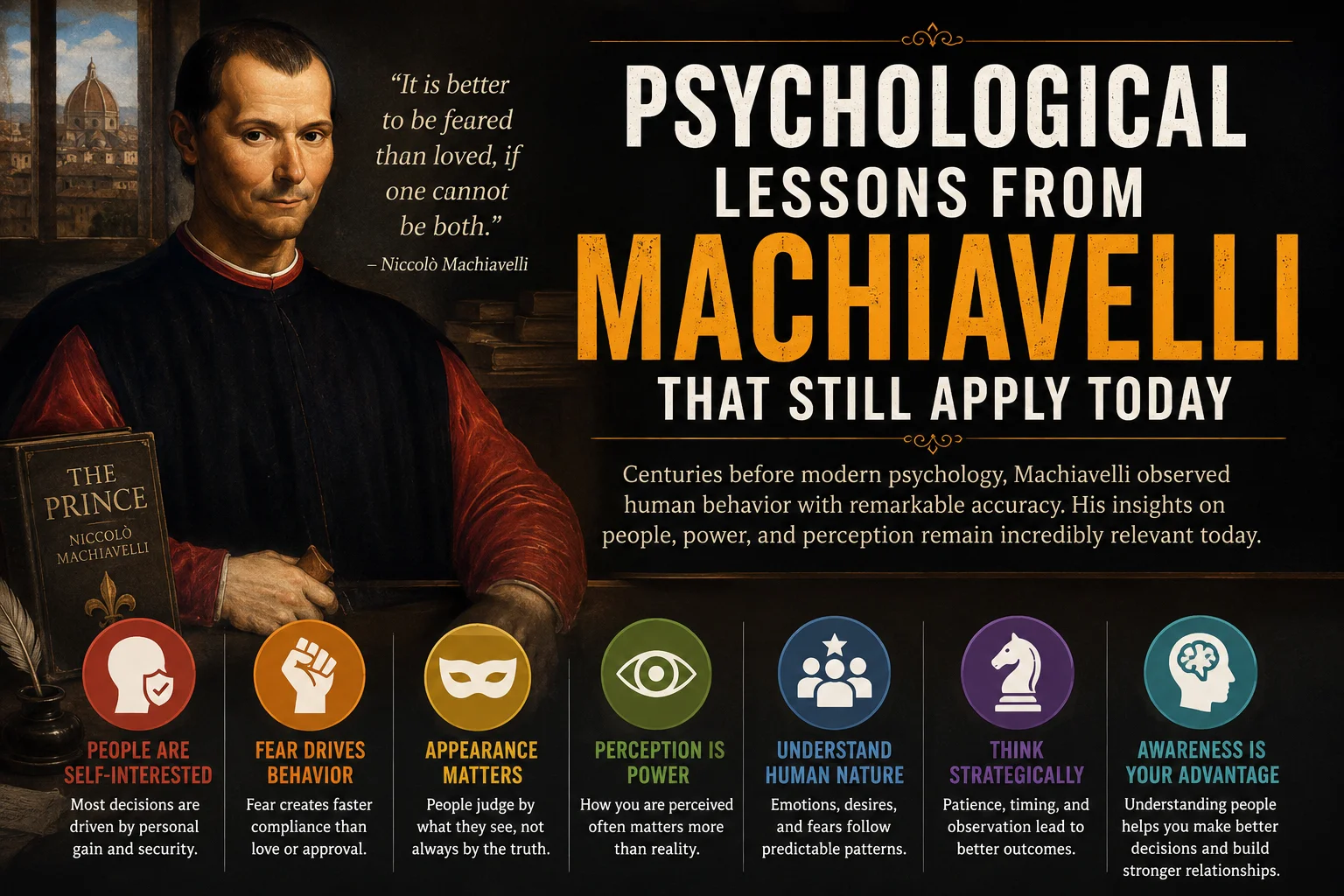
Niccolò Machiavelli is often remembered as a controversial thinker associated with power and strategy. However, beyond the historical and political interpretations, many of his observations reveal surprisingly accurate insights into human psychology and behavioral patterns.
Centuries before modern psychology formally emerged as a scientific field, Machiavelli explored themes such as fear, trust, perception, emotional reactions, social influence, and self-interest. Many of these ideas continue to appear in contemporary research on personality, leadership, communication, and social behavior.
Rather than viewing Machiavelli only through politics, his writings can also be understood as an attempt to study how people behave under pressure, uncertainty, competition, and emotional influence. Several of his observations still resonate because they reflect recurring psychological tendencies that continue to shape human interactions today.
Why Machiavelli Still Matters in Psychology
Modern psychology studies:
- decision-making,
- emotional influence,
- social perception,
- behavioral motivation,
- persuasion,
- interpersonal dynamics.
Machiavelli examined many of these same areas through observation of real human behavior rather than idealized morality. His ideas often focused on how people actually behave instead of how society expects them to behave.
This realism is one reason the term:
Machiavellianism
became an important concept in modern personality psychology.
Today, Machiavellianism refers to a personality pattern associated with:
- strategic thinking,
- emotional detachment,
- manipulation,
- calculated social behavior,
- focus on personal advantage.
The concept later became part of the well-known “Dark Triad” model alongside narcissism and psychopathy.
What Did Machiavelli Understand About Human Nature?
Humans Often Prioritize Self-Interest
One of Machiavelli’s central observations was that people are strongly motivated by personal benefit, security, and survival.
Modern psychology supports this idea through several theories:
- evolutionary psychology,
- self-preservation mechanisms,
- reward-based behavior,
- social exchange theory.
Human behavior is frequently influenced by perceived rewards, emotional safety, social status, and personal outcomes. People may cooperate, trust, or remain loyal when they believe the relationship benefits them emotionally, socially, or materially.
This does not mean humans are incapable of empathy or kindness. Instead, it highlights that self-interest often plays a significant role in decision-making.
Fear Creates Strong Behavioral Responses
One of Machiavelli’s most discussed ideas is that fear can influence behavior more reliably than affection alone.
From a psychological perspective, fear activates:
- survival instincts,
- threat awareness,
- emotional urgency,
- protective behavior.
Modern neuroscience shows that fear-based responses are deeply connected to brain systems involved in survival and risk detection.
Fear can:
- increase compliance,
- create short-term control,
- heighten attention,
- influence decision-making.
However, psychology also shows that long-term fear-based environments can damage:
- trust,
- emotional stability,
- motivation,
- relationship quality.
This creates an important distinction between short-term behavioral control and long-term psychological well-being.
Perception Influences Reality
Machiavelli understood that people respond not only to truth, but also to appearances, impressions, and social perception.
This idea closely relates to modern concepts such as:
- impression management,
- social image,
- reputation psychology,
- cognitive bias,
- the halo effect.
Human beings naturally form quick judgments based on:
- confidence,
- appearance,
- communication style,
- emotional expression,
- social status signals.
Research in social psychology confirms that perception strongly shapes:
- trust,
- credibility,
- attraction,
- authority,
- influence.
In many situations, how a person is perceived can affect outcomes as much as actual ability.
Emotional Reactions Are Predictable
Machiavelli carefully observed recurring emotional patterns in human behavior.
He noticed that people commonly react to:
- fear,
- uncertainty,
- ambition,
- insecurity,
- desire for approval,
- loss of control,
- competition.
Modern behavioral psychology similarly studies predictable emotional responses through:
- cognitive patterns,
- emotional conditioning,
- behavioral reinforcement,
- motivational systems.
Understanding these patterns can improve:
- communication,
- conflict management,
- emotional intelligence,
- interpersonal awareness.
People Are Influenced by Social Power
Another important psychological insight involves the effect of perceived power and authority.
People often behave differently around individuals they perceive as:
- dominant,
- confident,
- successful,
- respected,
- influential.
This connects with research on:
- authority bias,
- social hierarchy,
- dominance behavior,
- status psychology.
Humans are highly responsive to social structures and perceived leadership signals. Even subtle displays of confidence or authority can influence group behavior and decision-making.
The Psychological Side of Strategic Thinking
Machiavelli’s writings also emphasize observation, timing, patience, and emotional control.
From a modern psychological perspective, strategic thinking involves:
- impulse regulation,
- delayed gratification,
- emotional awareness,
- behavioral prediction,
- social intelligence.
These skills are linked to executive functioning and emotional regulation in psychology.
Strategic thinking does not necessarily mean manipulation. In healthy forms, it can involve:
- thoughtful decision-making,
- emotional discipline,
- careful communication,
- situational awareness.
The Difference Between Awareness and Manipulation
One reason Machiavelli remains controversial is because his ideas are sometimes interpreted as encouraging manipulation.
However, understanding psychological patterns is not automatically unethical.
Modern psychology uses behavioral understanding to improve:
- leadership,
- therapy,
- communication,
- teamwork,
- emotional intelligence,
- conflict resolution.
The key difference lies in intention.
Behavioral awareness can either:
- support empathy and understanding,
or - be used for control and exploitation.
This distinction remains highly important in both psychology and everyday social interaction.
What Modern Psychology Agrees With
Several modern psychological findings support observations similar to Machiavelli’s ideas:
- People are influenced by emotional perception.
- Fear affects decision-making.
- Social status changes behavior.
- Humans often protect self-interest.
- First impressions strongly influence judgment.
- Emotional reactions can become predictable patterns.
- Strategic communication affects relationships and influence.
Although modern psychology adds ethical frameworks and scientific research, many foundational behavioral observations remain surprisingly familiar.
Conclusion
Niccolò Machiavelli continues to attract attention not simply because of politics, but because many of his observations reflect enduring patterns of human psychology.
His writings explored:
- fear,
- trust,
- emotional influence,
- perception,
- ambition,
- social behavior,
- strategic thinking.
Viewed through a psychological lens, Machiavelli can be understood as an early observer of human behavioral tendencies rather than merely a political strategist.
Many of the same patterns he described centuries ago continue to appear in modern research on personality, social behavior, leadership, and emotional influence — showing that while societies evolve, many aspects of human nature remain remarkably consistent.

Leave a Comment