
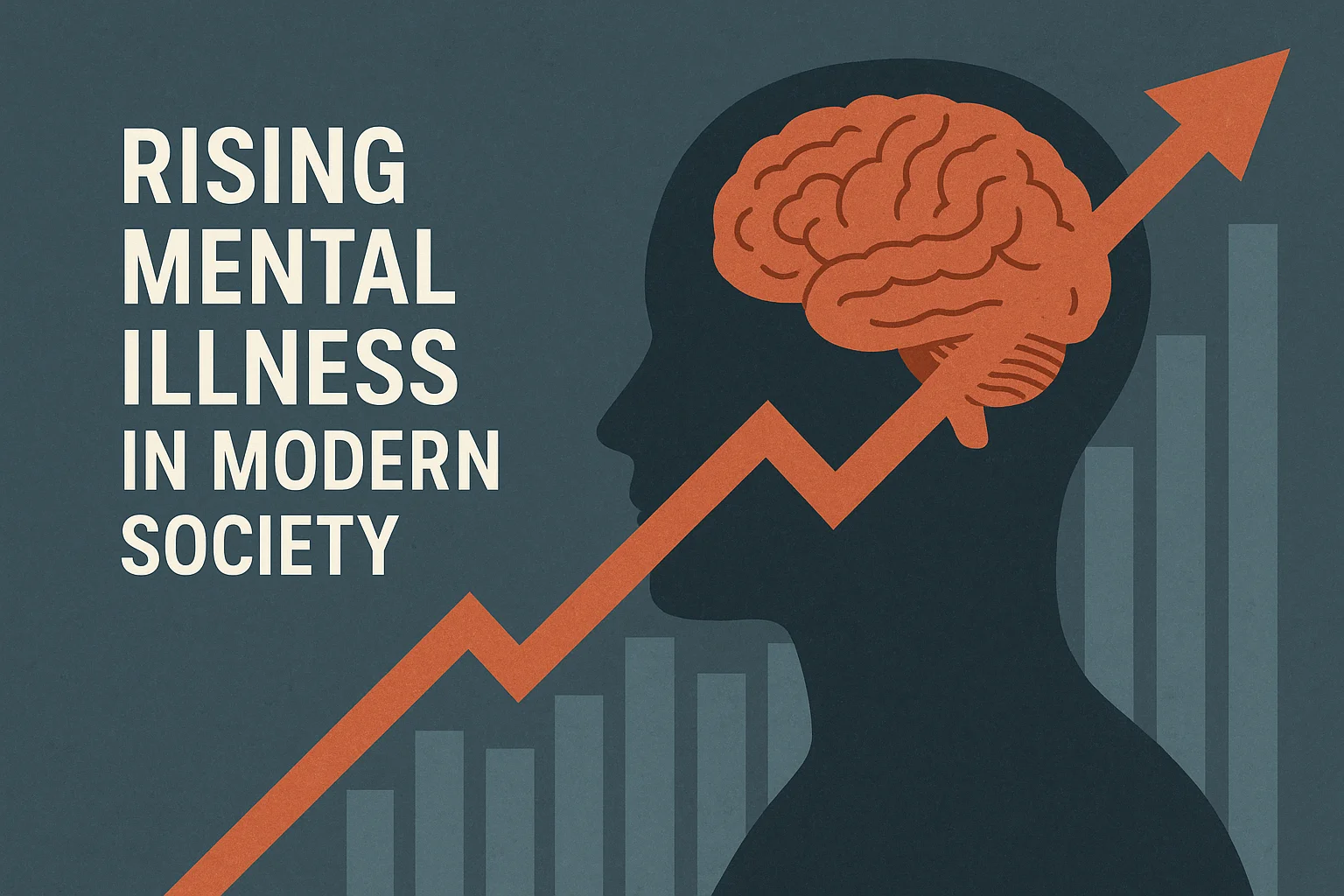
What does the latest data show about changes in mental-illness prevalence in the United States?
Research indicates that psychological distress has risen across the past decade, especially among younger adults. National data show that about 23.1% of U.S. adults reported experiencing “any mental illness” in 2022. Population-level surveys also reported increases in self-rated poor mental health across 2011–2022, although some indicators have recently stabilized.
While the degree of rise varies across studies, the overall trend points toward more people experiencing distress, impairment or persistent symptoms compared to a decade ago.
Why might mental illness appear to be increasing?
Several interacting social, psychological and environmental factors contribute to this trend:
- Intensified social and economic stressors: Rising cost-of-living pressures, job insecurity, rapid societal changes and the after-effects of the pandemic have increased chronic stress in daily life.
- Greater awareness and diagnosis: More individuals recognize symptoms, seek help and report distress, resulting in higher documented prevalence.
- Changes in lifestyle and social context: Remote work, reduced community structures, sleep disruption and sedentary lifestyle patterns contribute to emotional vulnerability.
- Digital-media influences: High exposure to social-media platforms can amplify social comparison, reduce sleep quality and increase loneliness—factors linked to higher rates of anxiety and depression.
- Younger generation pressures: Academic competition, digital immersion, economic uncertainty and identity-development stressors have made younger cohorts particularly susceptible.
Which groups show the most significant increases?
Young adults display the highest prevalence of mental-health challenges, consistently surpassing older age groups. Females report higher rates of anxiety and depression than males. Distress is also more concentrated among individuals living in economic disadvantage, and mental-health patterns vary among racial and ethnic groups. These inequities highlight how social environments and systemic factors shape vulnerability.
How much of the rise is a “real” increase versus improved detection?
A portion of the increase reflects genuine rises in distress and diagnosable disorders. However, improved screening tools, reduced stigma and broader diagnostic criteria also contribute to what appears to be a larger affected population. The picture is mixed: there are real increases, but also better visibility of struggles that previously remained unreported.
What psychological and behavioral mechanisms may be behind these trends?
Key mechanisms identified by current research include:
- Chronic stress and emotional overload, which can erode coping resources.
- Loneliness and decreased community connection, which are strongly tied to depression and anxiety.
- Sleep irregularities and circadian disruption, common in digitally connected lifestyles.
- Reduced physical activity, which correlates with lower mood and poorer regulation.
- Developmental pressures in adolescents and young adults, including digital-era learning environments and uncertainty about future stability.
These mechanisms interact, meaning no single factor explains the rise; rather, multiple lifestyle and environmental changes converge to shape mental health outcomes.
What are the practical implications for society?
Mental-health trends carry important implications for workplaces, educational settings, communities and health-care systems. Increasing demand highlights the need for:
- Accessible and affordable mental-health services
- Early-screening programs in schools and primary care
- Community-building initiatives to reduce loneliness
- Workplace environments that support psychological well-being
- Public awareness efforts to reduce stigma and encourage help-seeking
Strengthening social support systems appears especially important in addressing current and future needs.
What limitations should be kept in mind when interpreting this trend?
The rise is not uniform across all metrics. Variations in measurement, reporting tools and diagnostic thresholds complicate comparisons across time. Some surveys show stabilization in recent years, suggesting that increases are not accelerating in every population. Data also miss certain groups, leaving gaps in understanding. These limitations remind us that the picture is multifaceted and evolving.
What further research is needed to understand these changes?
Future work is needed to clarify causes and identify effective interventions. Priorities include long-term cohort studies, research on digital-media effects, data on underserved communities, investigations into economic and environmental stressors, and evaluation of preventive programs such as school-based mental-health interventions and community-level support systems.
Internal links
- https://behaviorfacts.com/cognitive-biases-and-mental-health
- https://behaviorfacts.com/lifestyle-interventions-anxiety-depression
External links
- https://www.nimh.nih.gov/health/statistics/mental-illness
- https://hsph.harvard.edu/news/mental-health-declined-among-u-s-adults-from-2011-to-2022
- https://jamanetwork.com/journals/jamanetworkopen/fullarticle/2829233

Leave a Comment