
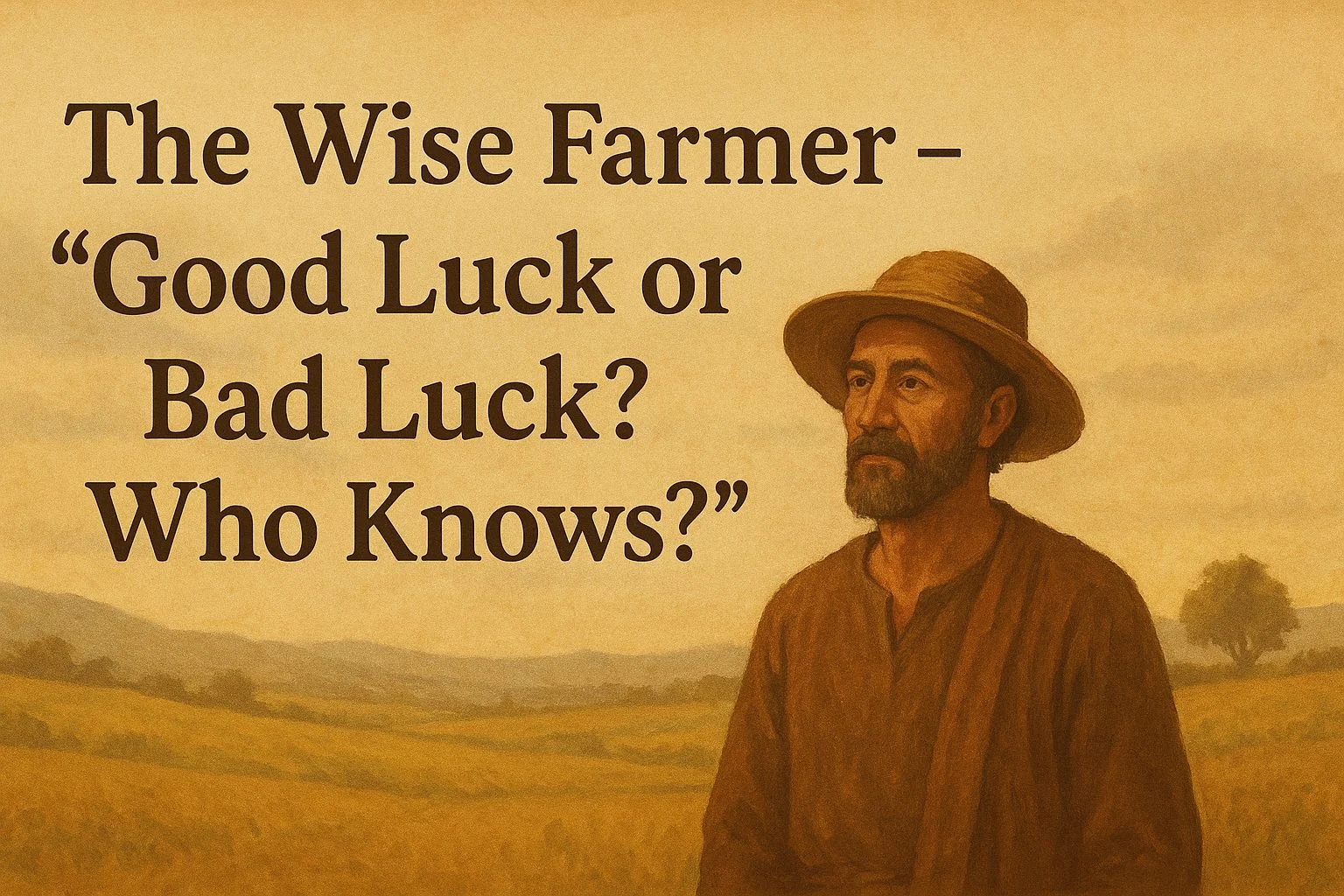
The Shifting Nature of Fortune
In a quiet village surrounded by rolling fields, there lived a farmer known for his calm spirit. No matter what happened — fortune or misfortune — he responded only with a gentle, steady phrase:
“Good luck or bad luck? Who knows?”
This timeless story has traveled through centuries, often attributed to ancient Chinese and Greek wisdom alike. Yet its essence mirrors one of the greatest truths of psychology and philosophy — that the meaning of events lies not in the events themselves, but in how the mind perceives them.
The Story of the Wise Farmer
One day, the farmer’s horse ran away.
His neighbors exclaimed, “Such bad luck!”
The farmer simply replied, “Good luck or bad luck? Who knows?”
A week later, the horse returned — bringing several wild horses with it.
The neighbors cheered, “How wonderful! Such good fortune!”
The farmer again replied, “Good luck or bad luck? Who knows?”
Soon after, his son tried to tame one of the new horses, was thrown off, and broke his leg.
“Such terrible luck!” the neighbors cried.
The farmer said calmly, “Good luck or bad luck? Who knows?”
A few days later, the army came to the village to recruit young men for war. Seeing the son’s injury, they left him behind.
The neighbors exclaimed, “What great luck!”
The farmer once more answered, “Good luck or bad luck? Who knows?”
And so the story continued — a cycle of joy and sorrow, neither permanent nor predictable. The farmer’s peace came not from what happened, but from how he chose to see it.
Philosophical Reflection: The Calm Beyond Judgment
The farmer’s wisdom captures the essence of Stoic philosophy — a perspective that teaches mastery of perception rather than control of events.
“You have power over your mind, not outside events. Realize this, and you will find strength.”
— Marcus Aurelius
The Stoics believed that the external world is neutral; it is our judgment that paints it as good or bad.
As Epictetus wrote:
“It’s not what happens to you, but how you react to it that matters.”
This ancient insight forms the foundation of psychological flexibility — the ability to accept, reframe, and respond rather than react. It’s a timeless principle that modern psychology continues to explore in the language of cognitive reframing and emotional regulation.
Psychological Reflection: Perception as the Architect of Emotion
Modern psychology agrees that emotions are not automatic outcomes of events, but interpretations filtered through cognition.
When something “bad” happens, the emotional experience depends largely on how the mind explains it.
This aligns with Cognitive Behavioral Therapy (CBT) — the most evidence-based form of modern psychotherapy.
CBT teaches that our thoughts shape our feelings, and by changing our interpretations, we can transform our emotional experience.
For example:
- Thought: “Losing my job means I’m a failure.” → Emotion: despair.
- Reframed Thought: “Losing my job means I have a chance to redirect my life.” → Emotion: hope.
The event remains the same, but perception shifts the outcome — just as the wise farmer saw both loss and gain as temporary movements in life’s larger flow.
“We suffer more often in imagination than in reality.”
— Seneca
This quote from Seneca beautifully captures what psychologists call catastrophic thinking — the human tendency to exaggerate potential loss and ignore resilience.
Awareness of this pattern allows us to pause and reframe, turning emotional chaos into composure.
Modern Research: The Science of Reframing
Contemporary studies continue to validate what Stoicism intuited centuries ago.
According to Harvard Health, cognitive reframing improves emotional balance and reduces stress responses by shifting attention from threat to opportunity.
Similarly, the American Psychological Association emphasizes that resilience is less about avoiding distress and more about how flexibly we interpret it.
This flexibility activates neural pathways linked to emotional regulation — particularly in the prefrontal cortex — allowing us to manage strong emotions with awareness instead of automatic reaction.
When we respond with reflection instead of reflex, the mind mirrors the wisdom of the farmer: open, calm, and adaptive.
Emotional Regulation and Stoic Equanimity
Emotional regulation — the ability to manage emotional responses — lies at the heart of psychological well-being.
The Stoics practiced this through equanimity: a calm acceptance of uncertainty and change.
“Man is disturbed not by things, but by the views he takes of them.”
— Epictetus
Psychologists describe a similar concept as emotional granularity — naming and understanding emotions with precision to prevent them from controlling behavior.
Mindfulness and acceptance-based therapies build on this foundation, teaching that awareness interrupts reactivity.
By cultivating equanimity, we move from being inside our emotions to observing them — a subtle but powerful shift in consciousness.
For deeper insight, see Mindfulness and Emotional Regulation – APA.
Practical Reflection: How to Think Like the Wise Farmer
To apply the wisdom of the farmer in everyday life:
- Pause Before Judging.
When an event occurs, resist labeling it immediately as good or bad. Give it space to unfold. - Ask Reflective Questions.
“What else might this mean?” or “What could this make possible?” — reframing broadens emotional perspective. - Name the Emotion.
Label what you feel without amplifying it. “I’m anxious.” “I’m disappointed.” Naming reduces emotional power. - Practice Temporary Thinking.
Remember that every experience is transient — both joy and sorrow evolve. - Train the Mind in Calm Curiosity.
Replace “Why is this happening to me?” with “What is this teaching me?”
These micro-shifts turn emotional reactions into opportunities for psychological growth.
Conclusion: The Psychology of Perspective
The story of the wise farmer teaches a quiet but profound truth — that we can’t always predict where fortune ends and misfortune begins.
Events in themselves carry no final meaning; it is the mind’s interpretation that writes the story.
Modern psychology and ancient philosophy meet at this intersection: peace is not the absence of problems, but the presence of perspective.
“The happiness of your life depends upon the quality of your thoughts.”
— Marcus Aurelius
When we stop labeling every event as good or bad, we open space for resilience, wisdom, and calm.
Like the wise farmer, we learn to meet life’s uncertainty with gentle curiosity — not resistance.
Internal Links

Leave a Comment